
Project Description
This project was part of the Kaplan Startup Accelerator Program, where 7 teams were selected out of 20 to participate in a 14-week journey from ideation to market launch. Throughout the program, we were guided by experienced coaches and mentors as we identified a problem, conducted research, built prototypes, tested ideas with real customers, and pitched our solution at the Pitch Tank Competition for a $25,000 cash prize.
We focused on the construction industry, where we identified a client and built an AI-powered application that streamlines the RFP process. The platform creates a knowledge repository from the company’s existing assets, generates key insights, and establishes an efficient workflow that speeds up RFP responses significantly reducing turnaround time and saving hours of manual effort.
SKILLS
Product Strategy
AI Interaction Design
ROLE
Product Designer
TIMELINE
14 weeks, 2025
TEAM
Founder
Chief Operating Officer
Product Designer (me)
Market Research & Brand Designer
Business Development & Sales Lead
AI Engineer
Senior Architect Engineer
Team of student Developers
Key Contributions
• As a product designer, I defined the user flows and shaped the product experience, integrating AI features that helped our customer save hours of manual work and focus on more strategic decisions.
• I translated research into clear, actionable insights and turned them into a minimum viable product that played a key role in securing our first MVP customer.
• I collaborated with the team to design a storytelling-driven pitch deck that clearly articulated our vision, highlighted the solution’s impact, and showcased our market potential, helping us connect with stakeholders and investors on both a business and emotional level.
CLIENT
Problem overview
In the construction industry, the Request for Proposal (RFP) process serves as the foundation for securing projects and partnerships, yet it remains one of the most complex, fragmented, and time-intensive stages in the project lifecycle.
Despite advancements in project management software, most companies still rely on manual documentation to create, distribute, and evaluate RFPs. This leads to a ripple effect of inefficiencies across all stakeholders, from project owners drafting the RFPs, to contractors preparing proposals, and evaluators comparing bids.
Why this problem matters?
The inefficiencies in the RFP process have a direct business impact.
• Projects experience delayed starts due to prolonged bid evaluations.
• Companies lose opportunities because of unclear requirements or missing documents.
• Teams experience frustration, burnout, and loss of trust in digital tools that don’t adapt to their workflow.
Introduction:
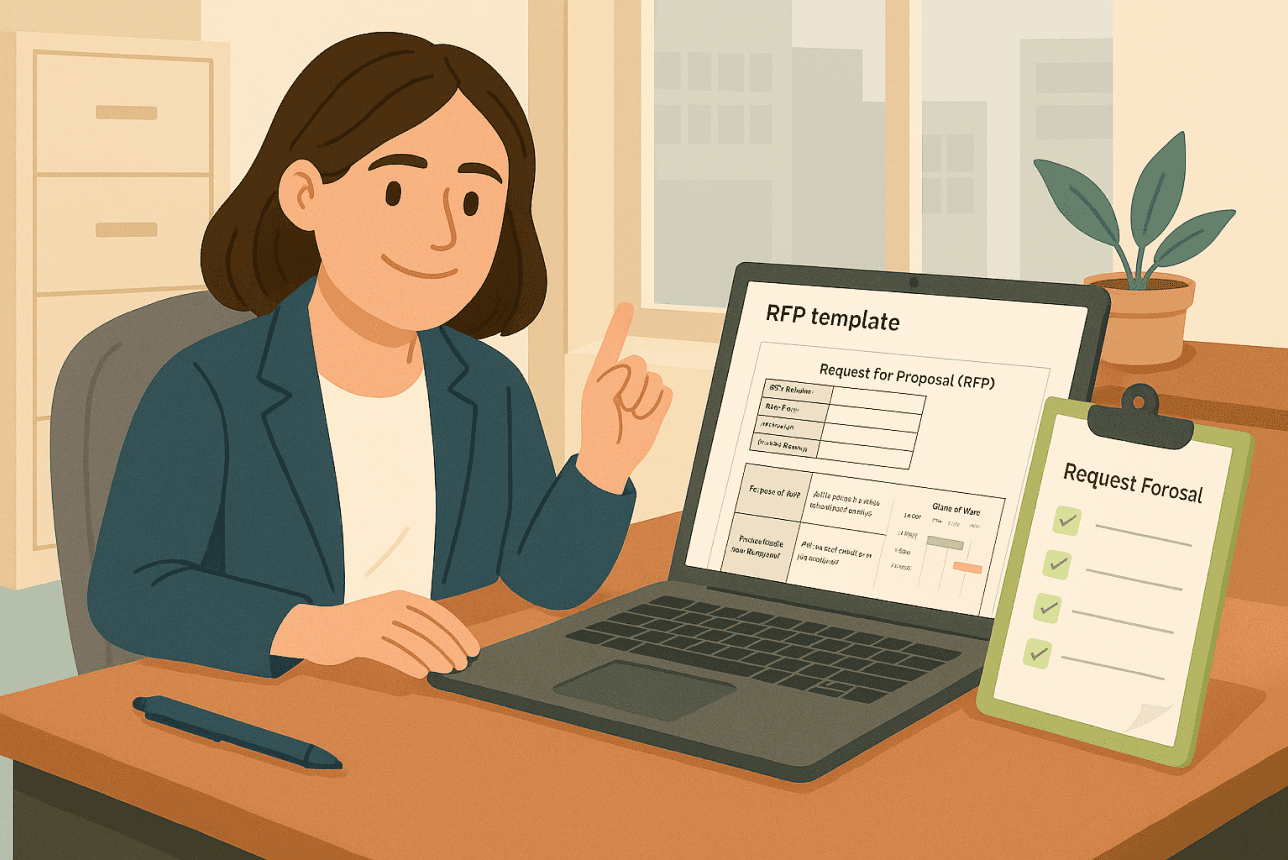
Request for Proposal (RFP)
RFP is a formal document created by project owners or RFP managers to invite contractors or service providers to bid on a project. It outlines key details such as the project scope, technical needs, budget, timeline, and evaluation criteria, helping the owner choose the most suitable partner to carry out the work.
CONTEXT
Let’s zoom out a little to understand everything about request for proposal
Who is involved in the process?
Contractor
The Contractor is the recipient of the RFP and plays the role of responder. After reviewing the RFP, they quickly decide whether to pursue the opportunity, analyze project feasibility, and coordinate with internal teams to build a strong technical and financial proposal.
RFP Manager
The RFP Manager represents the client or organization initiating the construction project. Their goal is to define project requirements clearly and attract qualified contractors capable of delivering within scope, budget, and time. They are responsible for preparing and publishing the RFP document, which includes all technical details, drawings, timelines, and evaluation criteria.
OUR FOCUS
Key components of RFP document
Project Overview
Scope of work
Timeline & Budget
Qualification Criteria
Submission Criteria
Evaluation Criteria
Key stages of RFP process
RFP MANAGER’S ROLE
CONTRACTOR’S ROLE
Define project
Write & issue RFP
Publish & distribute RFP
Prepare bids
Submit RFP
Evaluate
RFP & select contractor
Project
Execution
Both negotiate
terms & price
How might we automate and enhance the efficiency of analyzing RFPs?
Framed the problem
The manager is responsible for drafting detailed RFP documents, responding to bidder queries, reviewing submissions, and maintaining transparency throughout the evaluation process all while juggling strict deadlines and compliance requirements.
Most of their workflow is still manual and repetitive. They rely on word templates, excel sheets, PDFs and long email chains to coordinate with contractors and internal teams. Information gets scattered across formats, making it difficult to track updates or ensure consistency.
As a result, the manager spends more time managing documents than managing decisions. This leads to delays, errors, and frustration.

We discovered that managing complex RFP processes across disconnected tools and stakeholders was their biggest challenge, often causing project delays.
PRIMARY INTERVIEW & SYNTHESIS
So what is the root problem?
To understand the problem better, we interviewed a construction firm that handles RFPs on a daily basis and spoke with their team to gain deeper insights into their workflow and challenges.

Proposed Solution
Our platform leverages the company’s data repository to automatically generate key insights from lengthy
RFP documents, such as project summaries, timelines and automated task allocations.

How our AI-based solution transforms RFP management
CURRENT STATE
OUR SOLUTION
RFP data scattered across emails and spreadsheets makes tracking difficult.
A unified AI-powered hub centralizes all RFP insights and documents.
Summaries and timelines are manually extracted from lengthy documents.
AI auto-generates concise project summaries and key deadlines in seconds.
Users spends hours searching through for relevant details.
AI instantly surfaces the right information when it’s needed.
Manual coordination leads to confusion and missed deadlines.
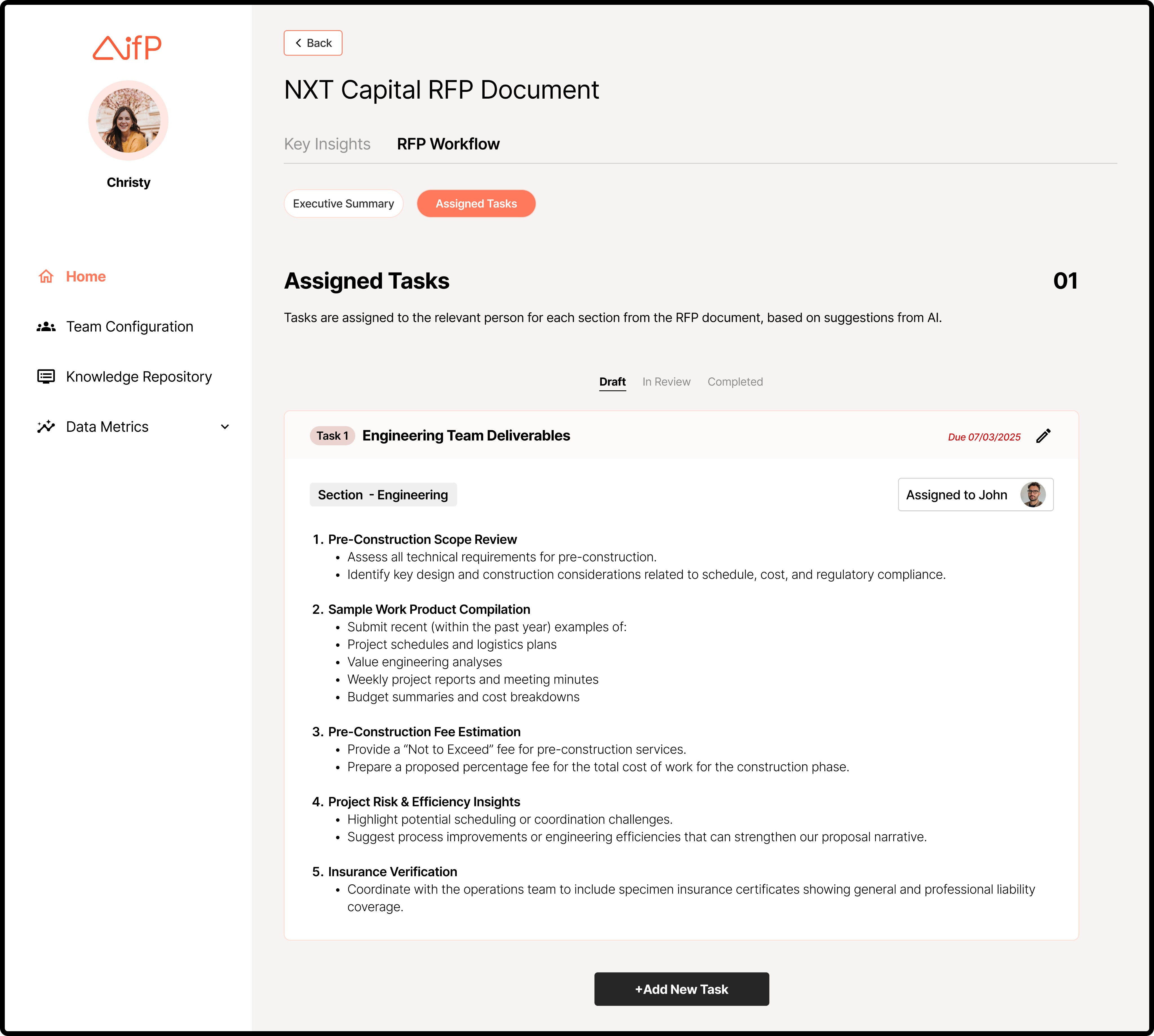
Tasks are auto assigned based on proposal data and team roles.
STRATEGY
Prioritised use cases
to build Minimum
Viable Product (MVP)
Use Case1: RFP Summary & schedule
Use Case 2.0: Intelligent RFP insights generation
Use Case 2.1: Role-based task assignment and collaboration
Use Case 2.2: Task reassignment and deadline management
Use Case 2.3: Task editing with AI assistance
Use Case 2.4: Task progress tracking and review workflow
Use Case 3: Global team configuration and collaboration
Use Case 4: Centralized knowledge repository for past proposals and other assets.
Use Case 5: Data metrics and performance insights
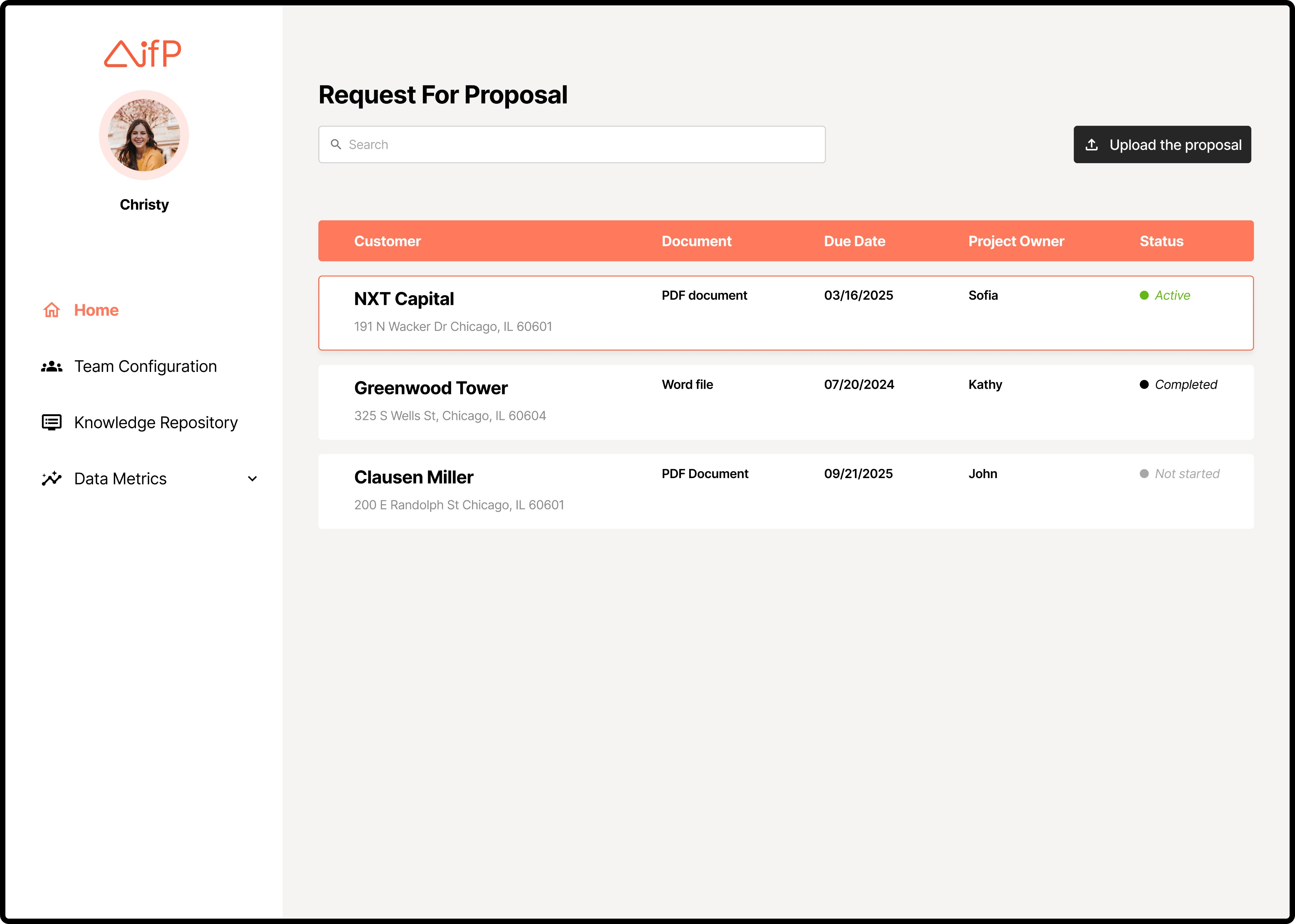
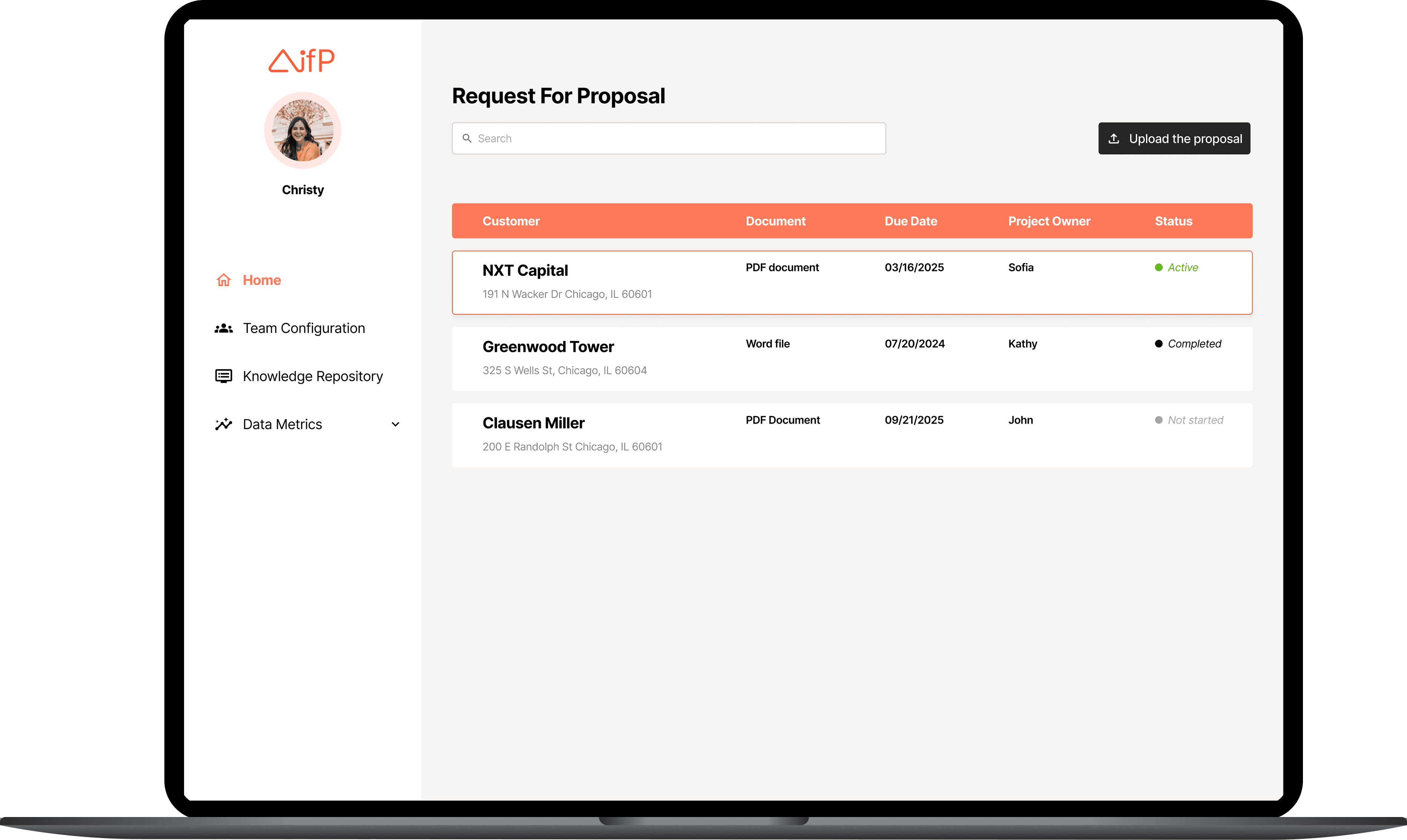
Final Product
Introducing an AI based RFP management platform that transforms how construction teams handle request for proposals
Use Case 1: RFP summary and schedule
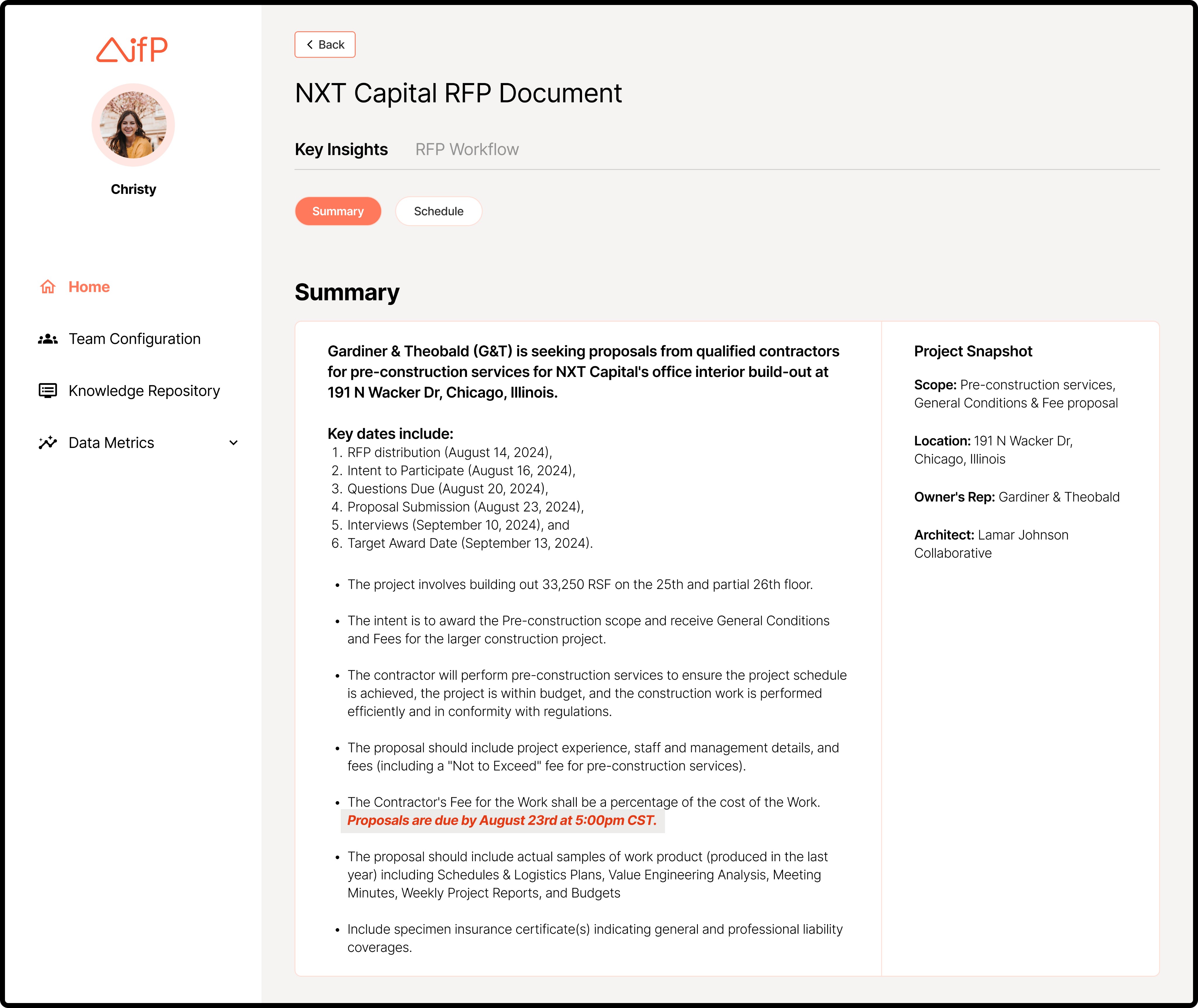
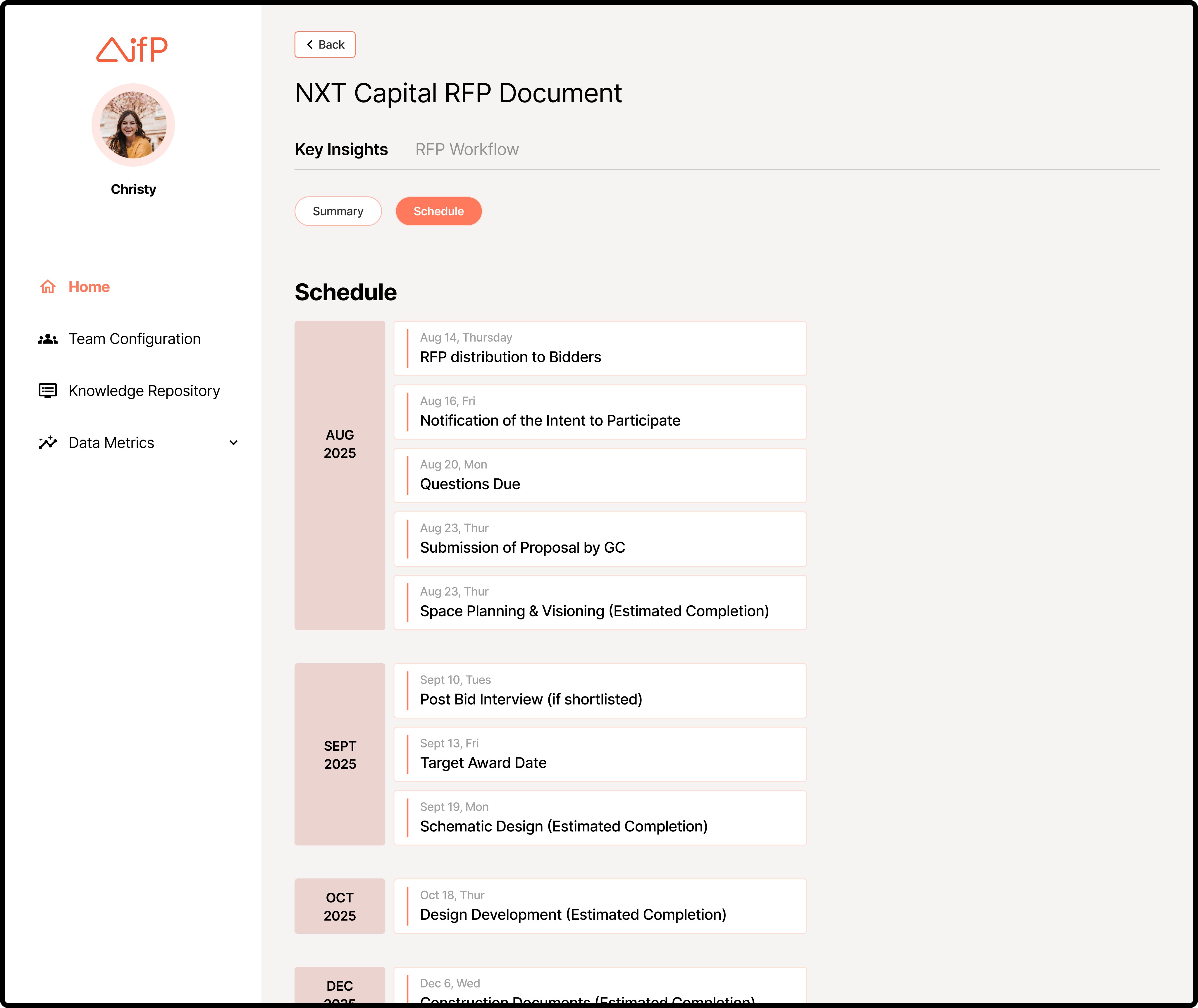
When user uploads a request for proposal document (e.g., PDF or DOCX) the system scans and extracts essential information.
Use Case 2.0: Intelligent RFP insights generation
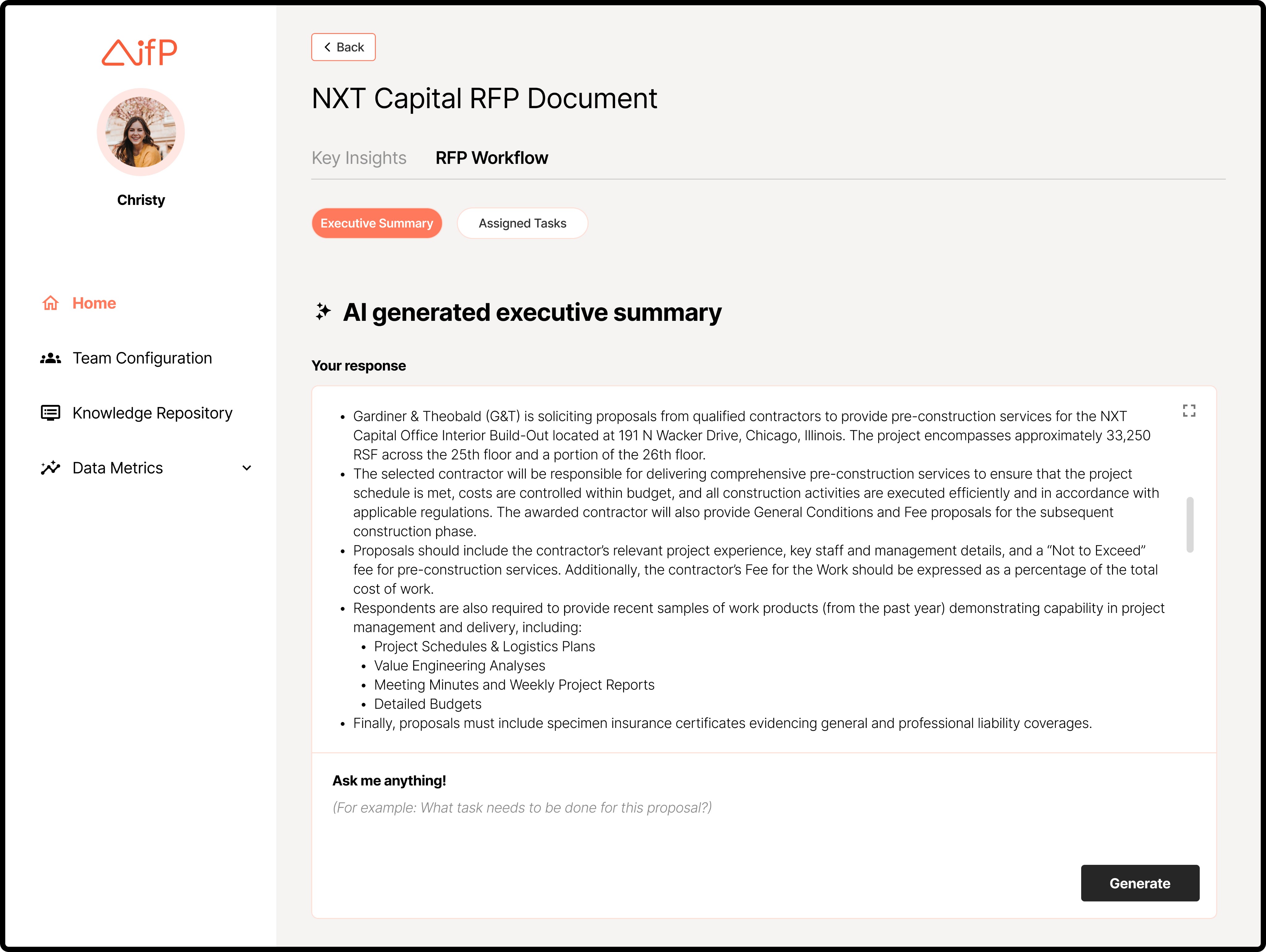
It generates an executive summary and allows users to type queries to instantly retrieve specific insights or details from the document.
Use Case 2.2: Task reassignment and deadline management
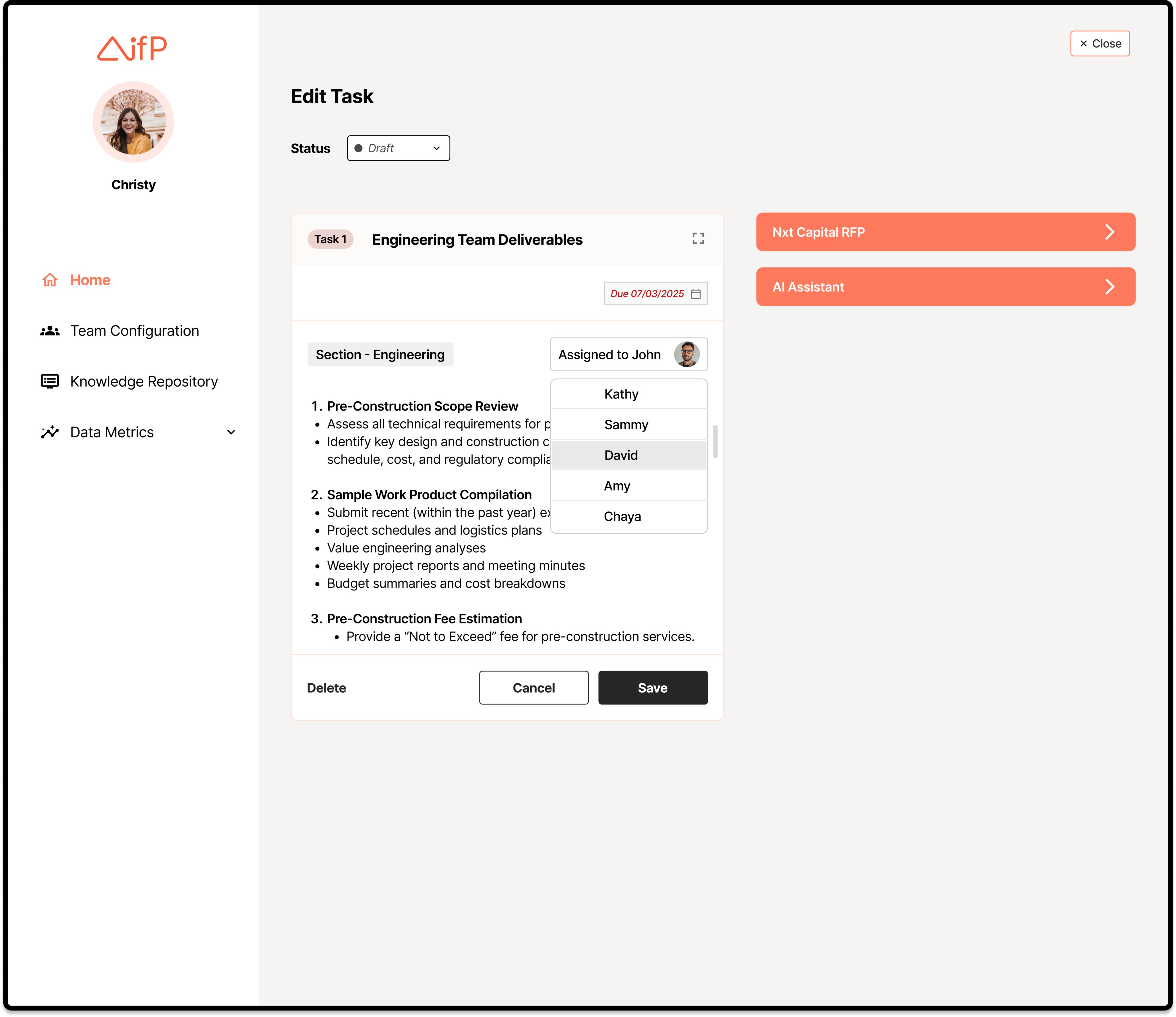
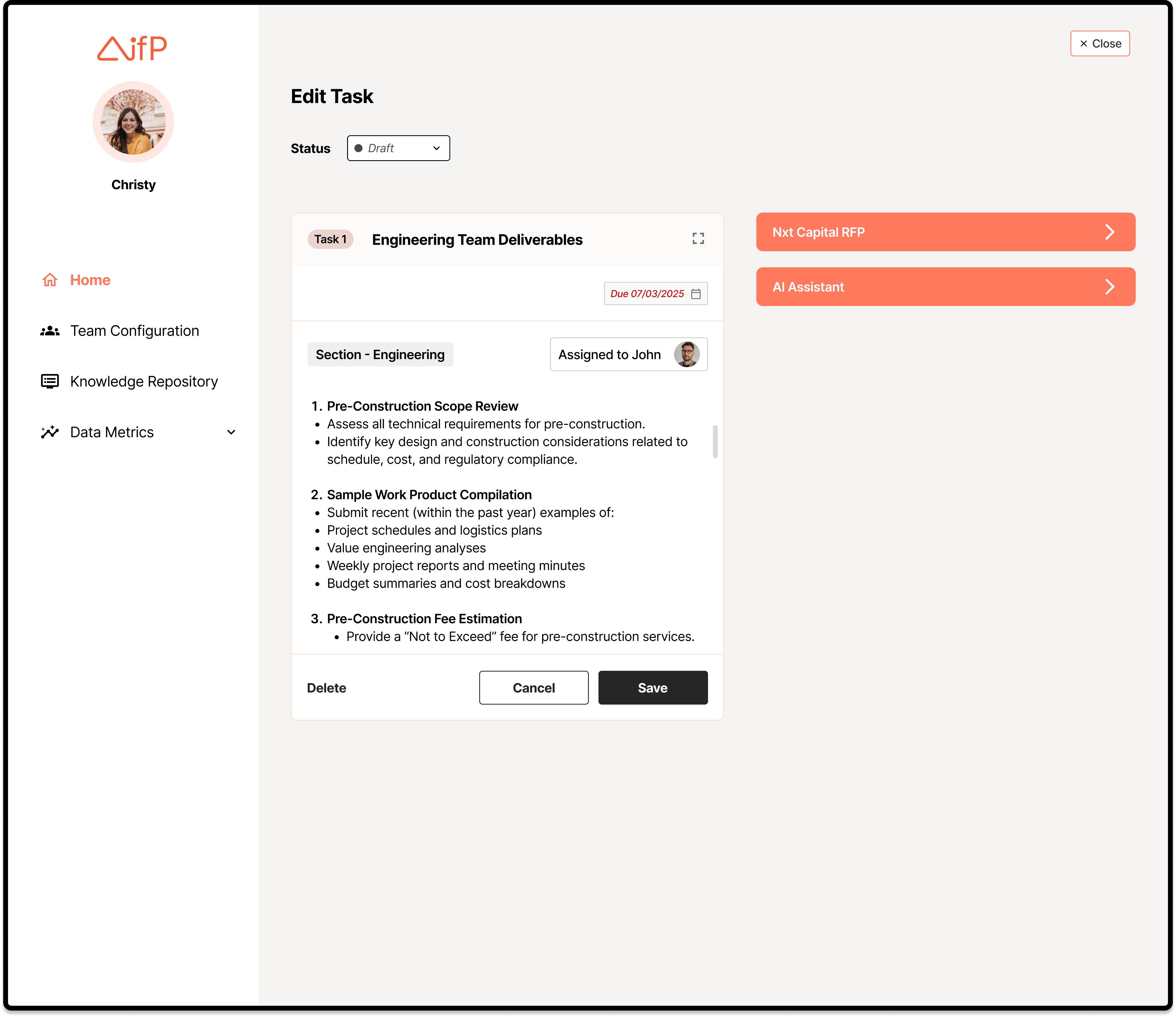
The system enables the project owner to easily modify task details such as due dates, assignees, and priorities directly within the proposal dashboard.
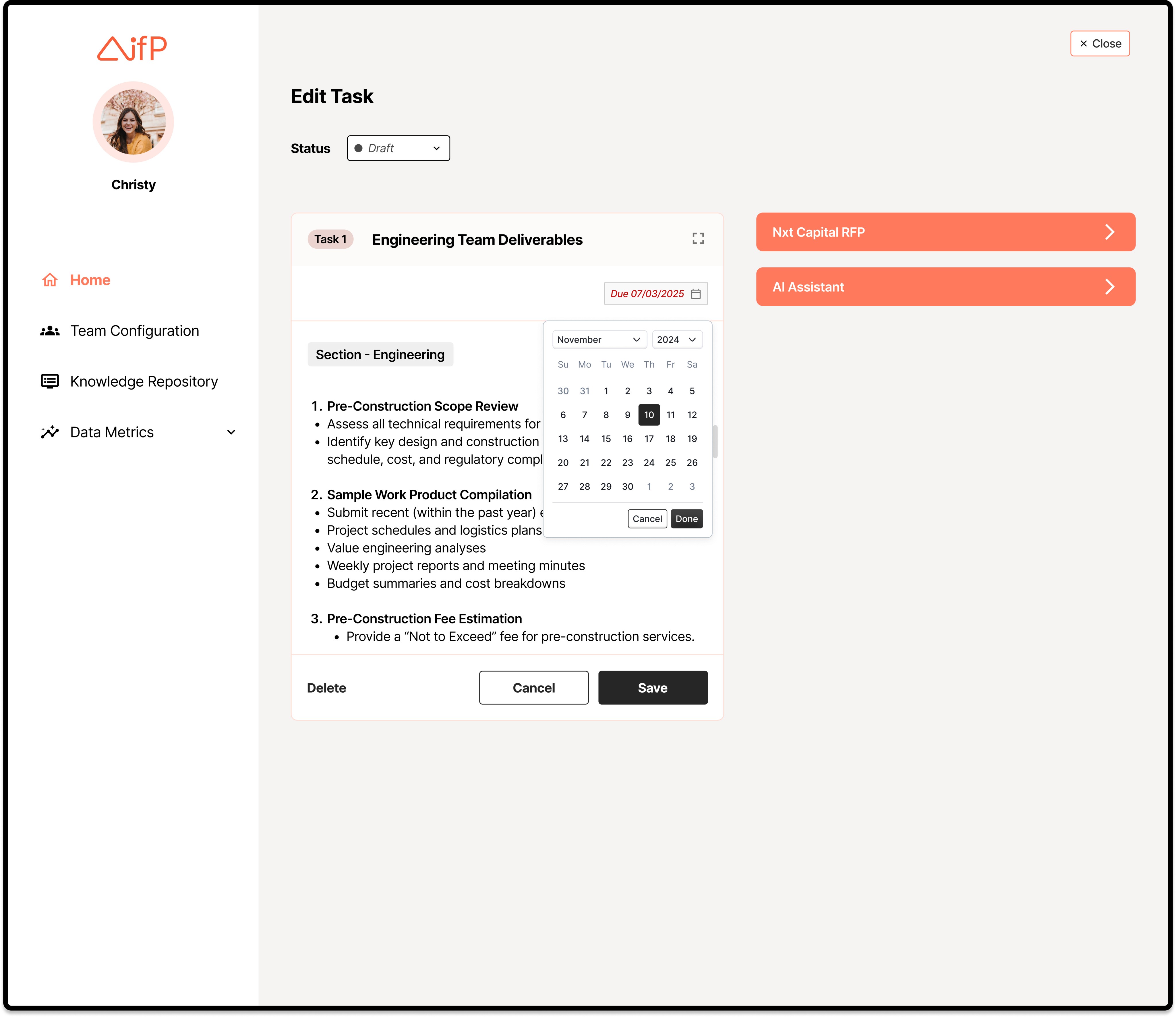
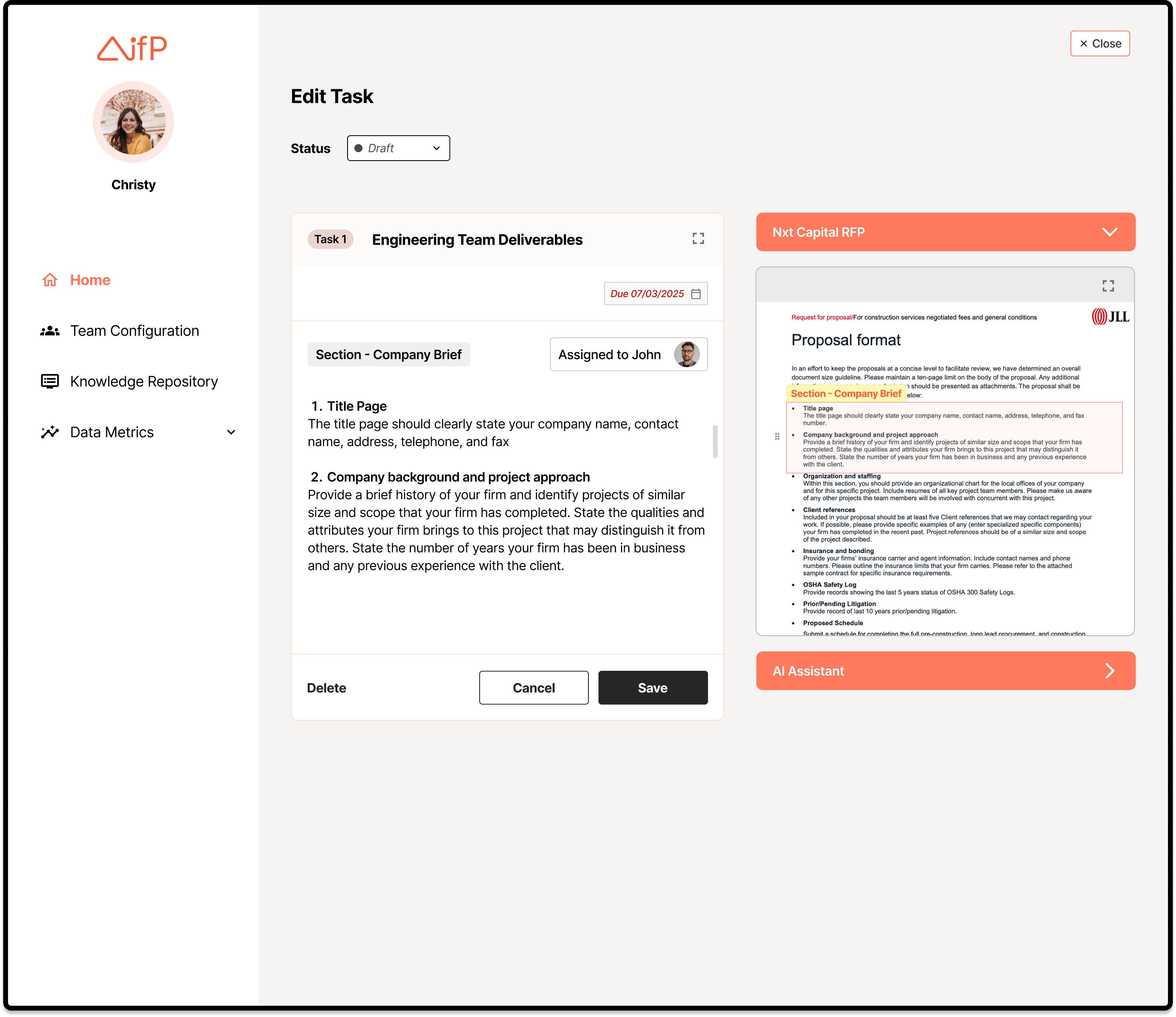
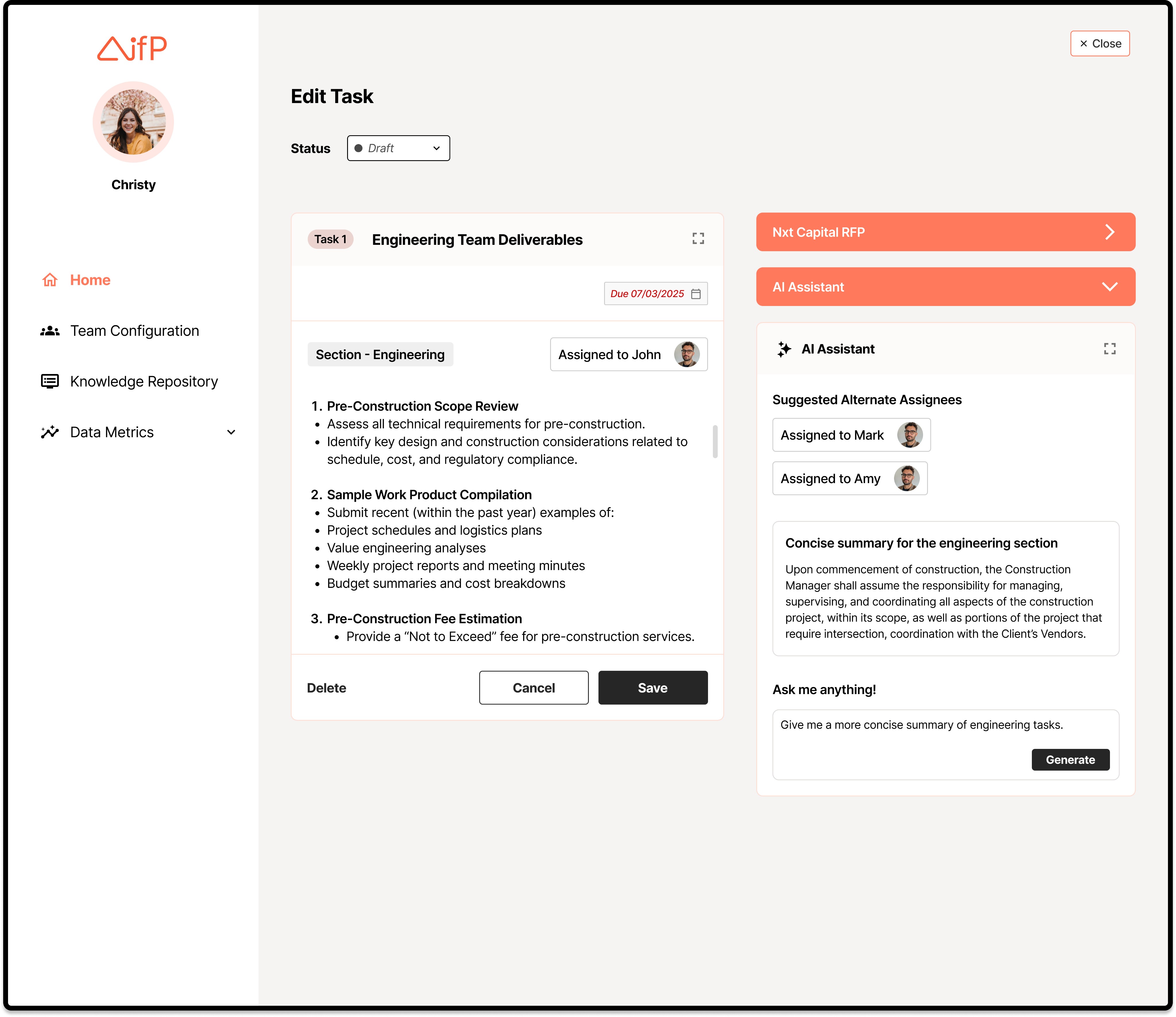
Use Case 2.3: Task editing with AI assistance
Users can hover over any section of the RFP document to edit tasks, while an AI assistant suggests content improvements, rewrites for clarity, and recommends suitable assignees based on task type and role.
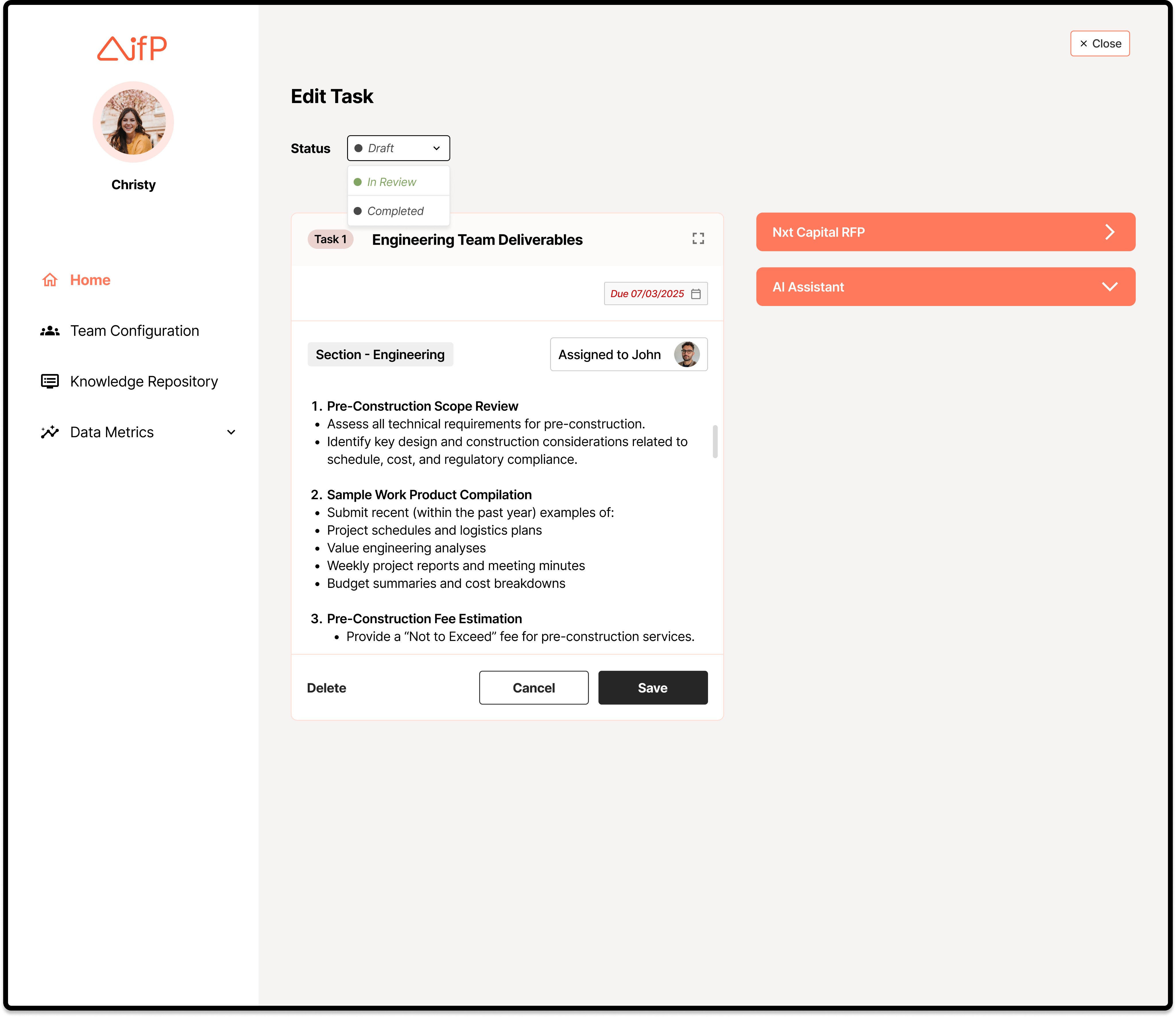
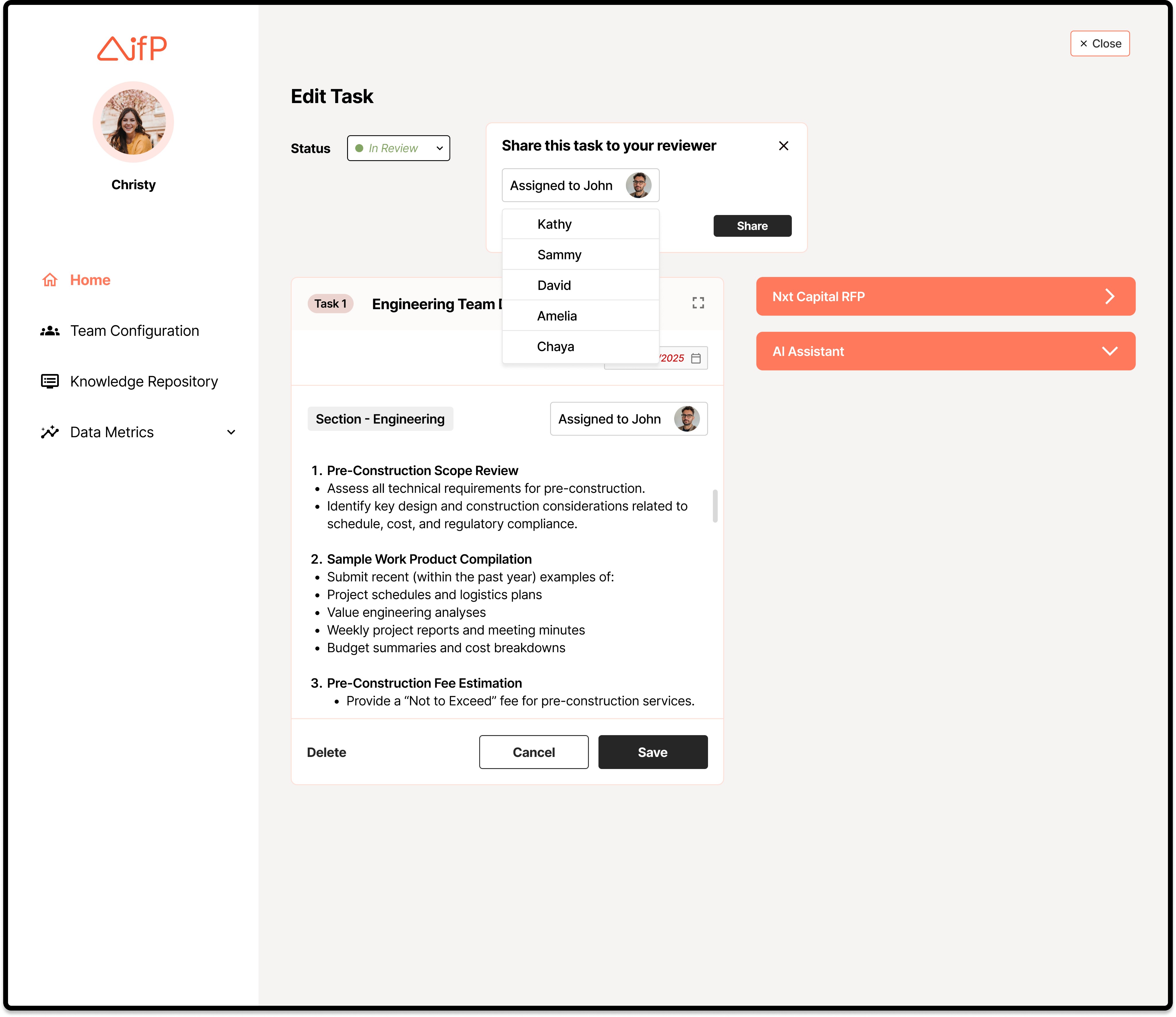
Provides project owners and teams with a transparent, flexible workflow divided into draft, in review, and completed stages, improving collaboration, accountability, and visibility while reducing errors through built-in review checkpoints.
Use Case 2.4: Task progress tracking and review workflow
Use Case 2.1: Role-based task assignment and collaboration
It auto assigns tasks to the appropriate team members according to their predefined roles (e.g., legal, finance, design, or technical) extracted from the RFP document.
What did we hear from the client?
I like (what worked)
“I liked how leveraging AI helps extract relevant information from the RFP document, it will save our team a lot of time.”
“The auto-assign task feature works really well; it will make task distribution much easier for our team.”
I wonder (opportunity to improve)
“Is there a way to filter and review previous proposals?”
“When we receive multiple proposals for the same work from different contractors, how can we determine which one is the right fit?”
We then presented our design solution to the client and received valuable insights from their feedback.
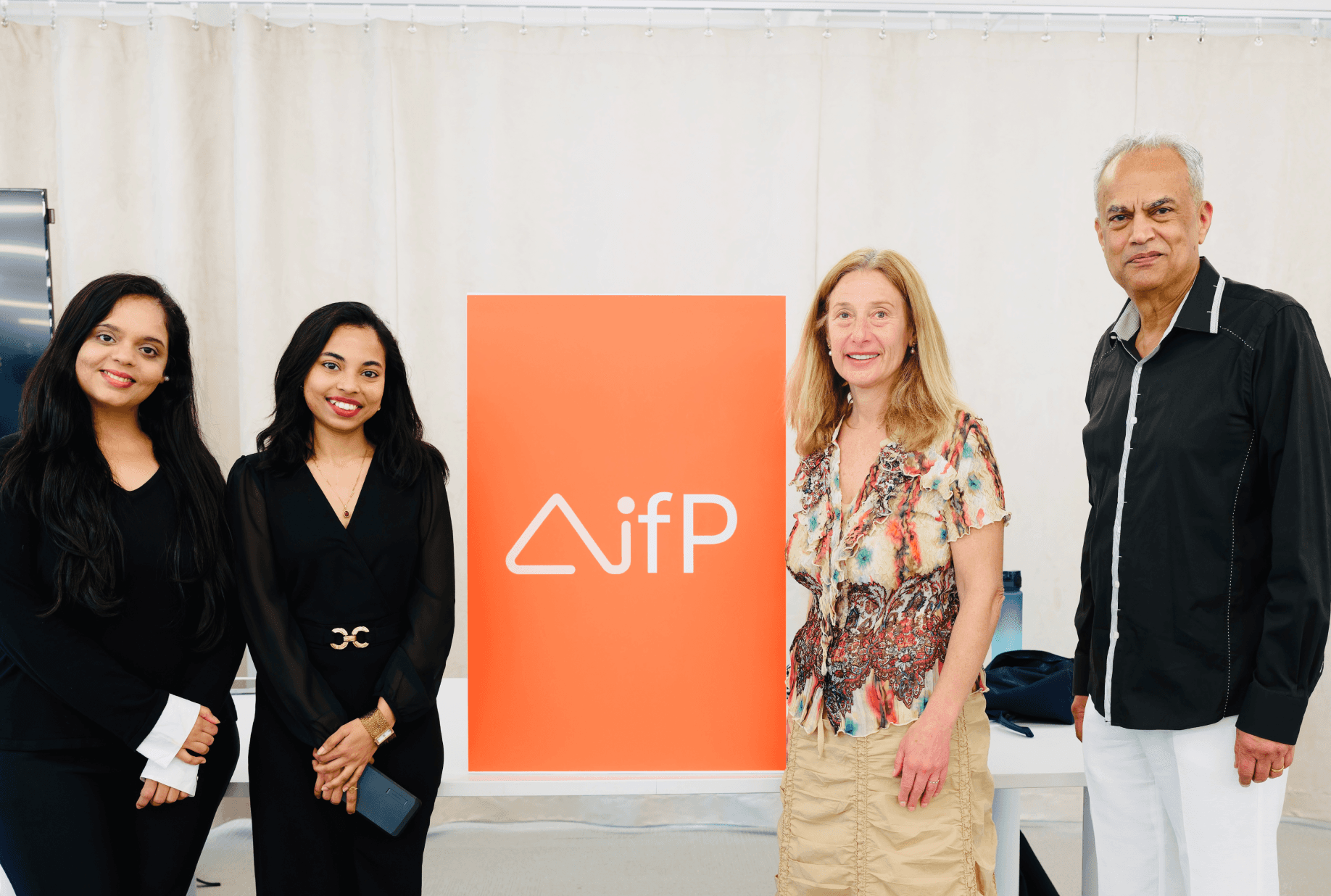
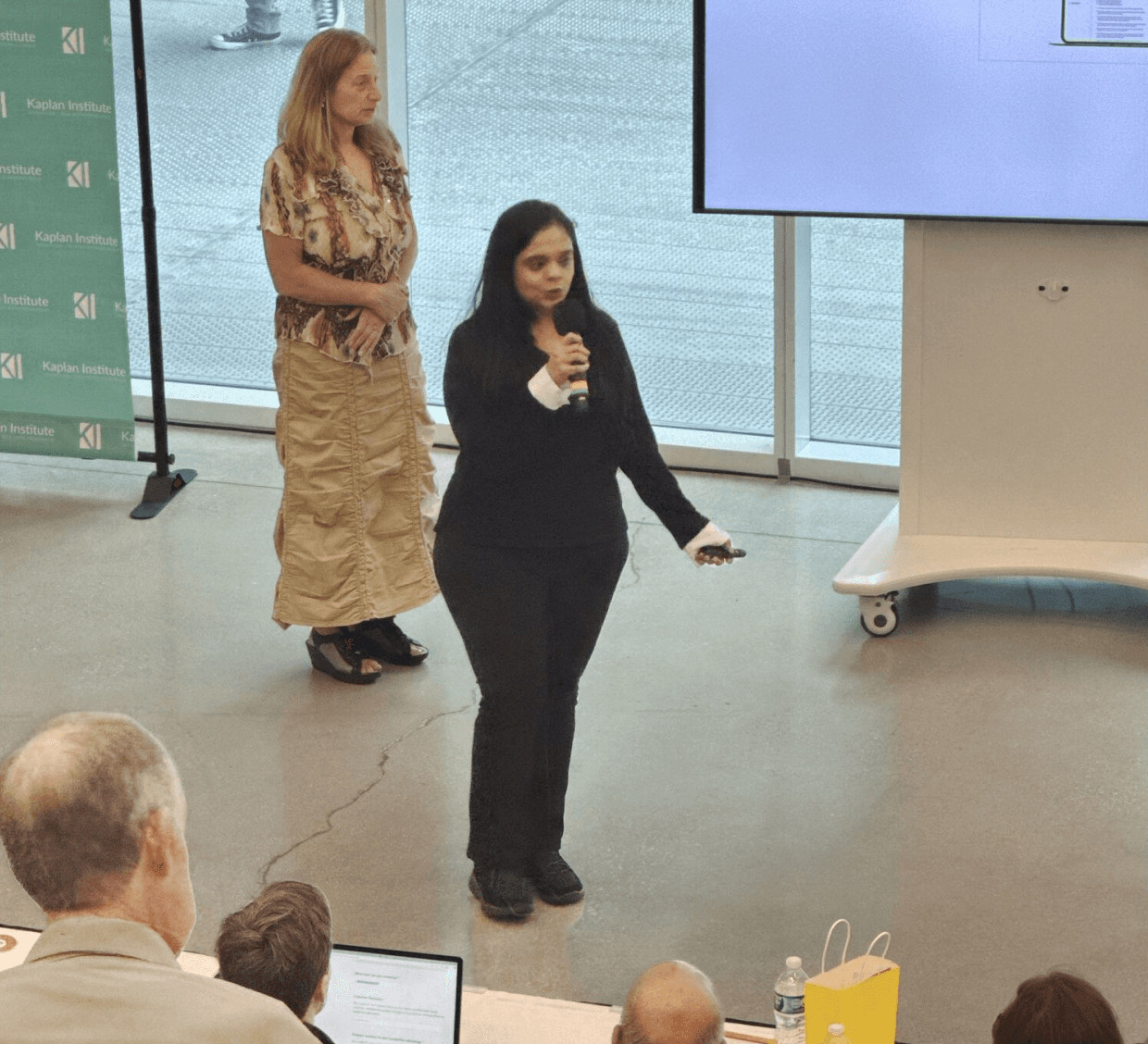
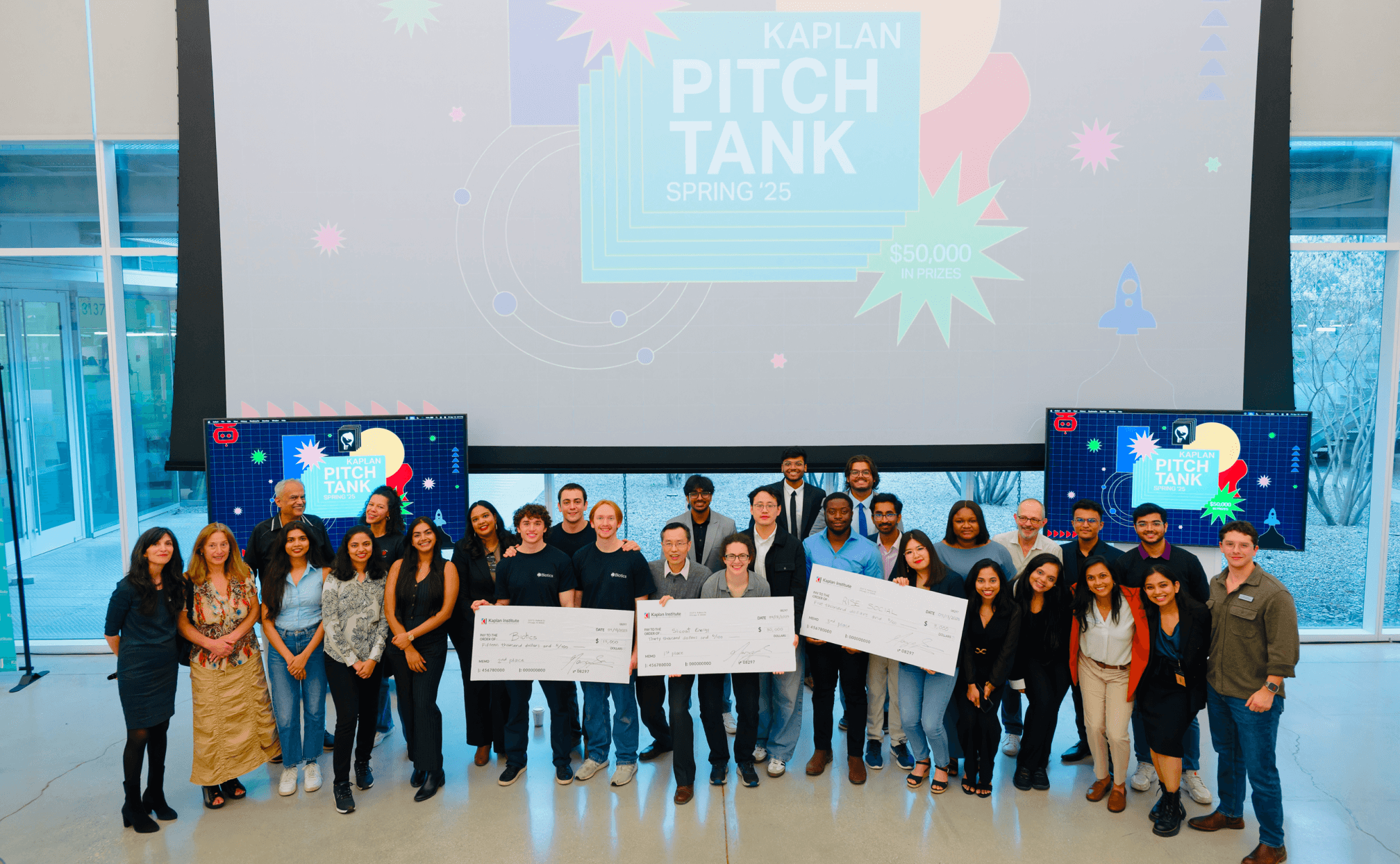
Presenting at
Kaplan Pitch Tank Competition
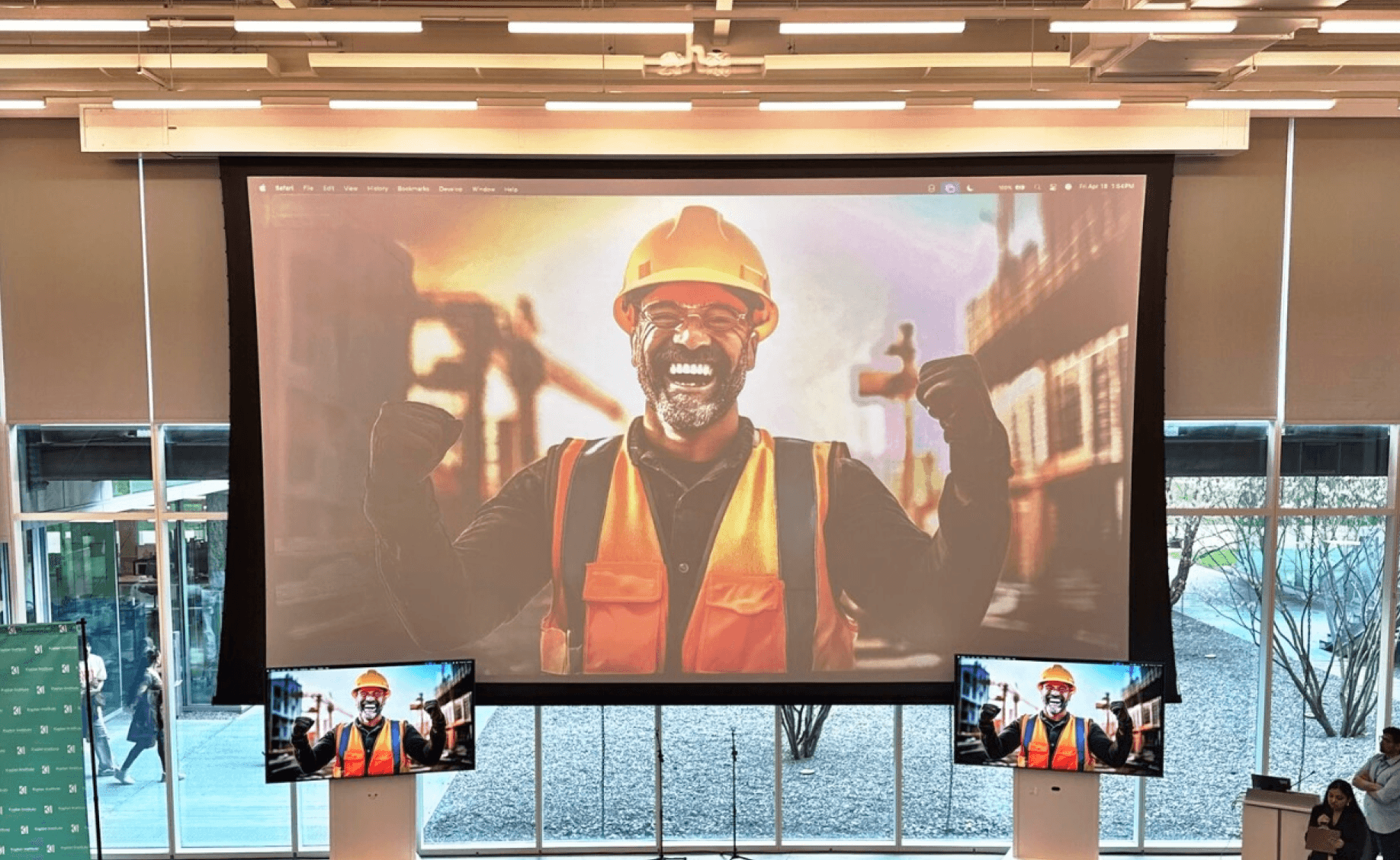
We pitched our vision in front of fellow students, investors, and industry leaders. I had the opportunity to share the stage with our founder and present our design solution. It was an inspiring experience to see every team come together, sharing their ideas with such passion and creativity.


Defined the core features that gave
team a direction.
7 product iterations & 20+ prototypes in less than a week.
Delivered the product concept that addressed
customer’s problem.
How did my contributions support the team in securing our first MVP customer
Start small, learn fast
I learned that starting small with fewer, simpler features helps move ideas forward faster. Building a lean version first is often more effective than investing early in a fully polished product.
Stay connected with the client
Since this project was part of a startup accelerator program, we had limited time to interact with the client. In the future, I would prioritize connecting with the client more frequently to gather feedback at multiple stages and evolve the product iteratively.
Design with end users, not just for them
I would also engage more closely with members of the client’s internal team, especially those who would actually use the product to better understand their day-to-day needs and challenges.
What did I learn? What would I do differently?
back to top
ANAM KORADIA 2025. ALL RIGHTS RESERVED.
HAND CURATED WITH LOVE, CARE & LOTS OF CHAI ☕️
THIS WEBSITE IS BEST VIEWED ON DESKTOP
If you like what you see then let’s
connect and build something together.

Anam Koradia
Thank you for being here.