
Project Description
This project was part of our Agile for Design Outcomes class, where our team was tasked with identifying and exploring different types of problems. We began by brainstorming a wide range of topics like mental health, mentorship, art therapy, financial literacy, and career transition all centered around the theme of young adults.
Among these ideas, we found ourselves most drawn to financial literacy, a topic that resonated deeply with our shared lived experiences. Although our team shares South Asian backgrounds, our diverse upbringings made us curious: Do cultural and parental values still influence how South Asian-American teenagers learn about money? We decided to focus on teens aged 13–19 as a pivotal stage where conversations about money can still be shaped, guided, and redefined.
Key Contributions
• Partnered with a teammate to conduct primary interviews with parents and teens, uncovering insights into financial communication and decision-making habits within families.
• Synthesized qualitative data from interviews to identify key themes such as trust, transparency, and control in parent-teen money conversations.
• Conducted secondary research to understand existing financial literacy tools and cultural factors influencing how South Asian-American families discuss money.
• Took the lead in developing a modified service blueprint, mapping the user journey and frontstage–backstage interactions to illustrate how the game would be delivered to parents and teens.
SKILLS
UX Research
Service Blueprint
Agile Methodologies
ROLE
UX Researcher & Designer
TIMELINE
14 weeks, 2025
TEAM
Tanvi Warghary
Sampada Pote
Vedika Mehwala
Bhairavi Ruparel
Anam Koradia (me)
TOOLS
Figma
Mural
Github
Zenhub
CLIENT

Where we started?
Initial assumptions
South Asian-American parents often take responsibility for educating their children about money from a young age and are generally open to having conversations about financial matters within the family.
Schools teach children about financial literacy helping them develop basic money management and decision-making skills.
CORE ISSUES
The lack of financial transparency in South Asian American families creates barriers to open communication and financial literacy across generations.
However in reality

I agree, let your father manage it. Right now you’re too young.
Son, you are not yet responsible to handle your own money.
01 / Cultural Taboos Around Money
Discussions about finances are often considered inappropriate or unnecessary, especially with children.
02 / Hierarchical Family Structures
Elders or male family members traditionally control financial decisions, limiting others' involvement or understanding.
03 / Generational Disconnect
Parents hesitate to share financial details due to fear of judgment or mistrust, being overprotective leaving children unprepared for financial independence.
INTERVIEW SYNTHESIS
We conducted 6 interviews
(3 parents & 3 teens)
Parent’s Point of View

“My son is too young to manage his money”

“I don’t trust him with money he might misuse it”

“Being too transparent and open will be overwhelming for him”
Teen’s Point of View
“I want to manage my money but I’m too afraid to ask”
“I don’t manage my own money, my father handles everything”
“I want to have more transparent conversion about money but I’m never included”
Key insights
Lack of transparency
Parents hesitate to give financial control because they fear misuse or immaturity.
Fear
Teens want to take responsibility but are anxious to initiate the discussion.
Communication gap
The lack of open dialogue widens the understanding gap between both sides.
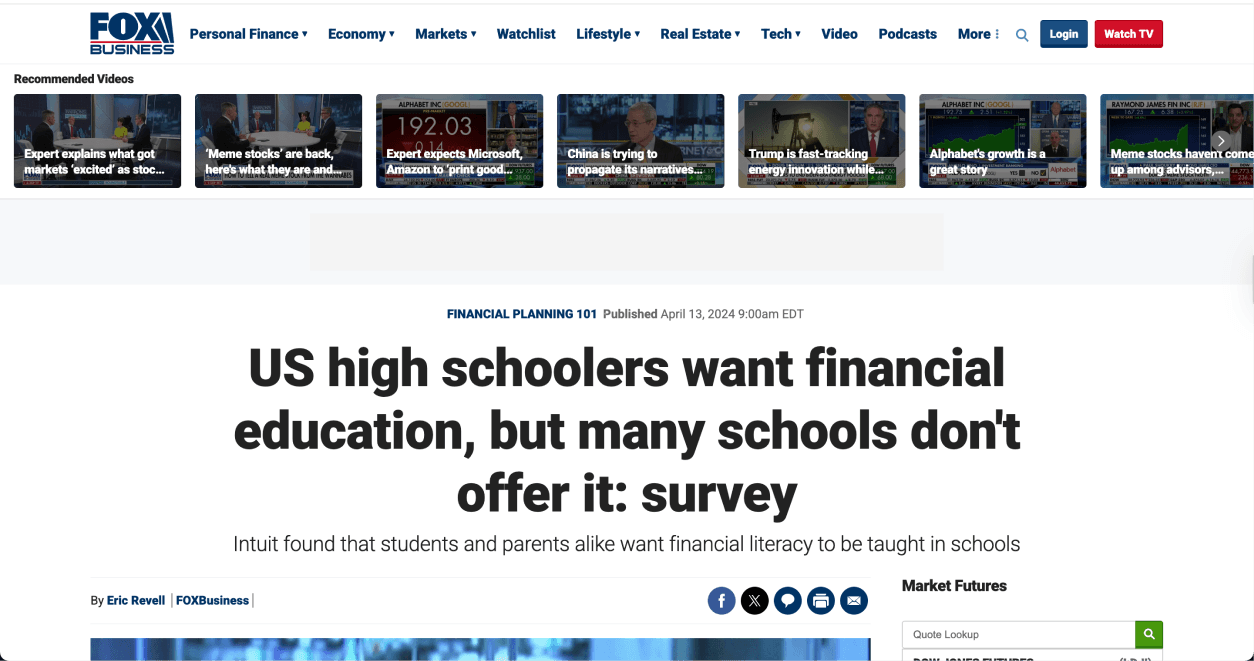
85% of U.S. high school students want to learn about personal finance, but many schools don’t offer it.
EXTERNAL ISSUES
Research showed that American schooling systems often fail to provide comprehensive financial literacy resources, leaving both parents and teens ill-equipped to navigate financial decision-making.

As a result teens struggle to develop financial literacy and healthy money management habits, as these topics are not freely discussed or taught within the family unit.
Thus we asked
How might we encourage parents and teens to have more open conversations about money?
For
South Asian-American teen (ages 13+) and their parents
Who
Struggle with financial education and independence due to cultural taboos in relation to knowledge of modern finance skills
Our
Physical interactive activity
Is
Culturally collaborative gaming experience
That
Bridges generational gaps to foster open discussions for families to build financial literacy while honoring cultural values.
Goal statement
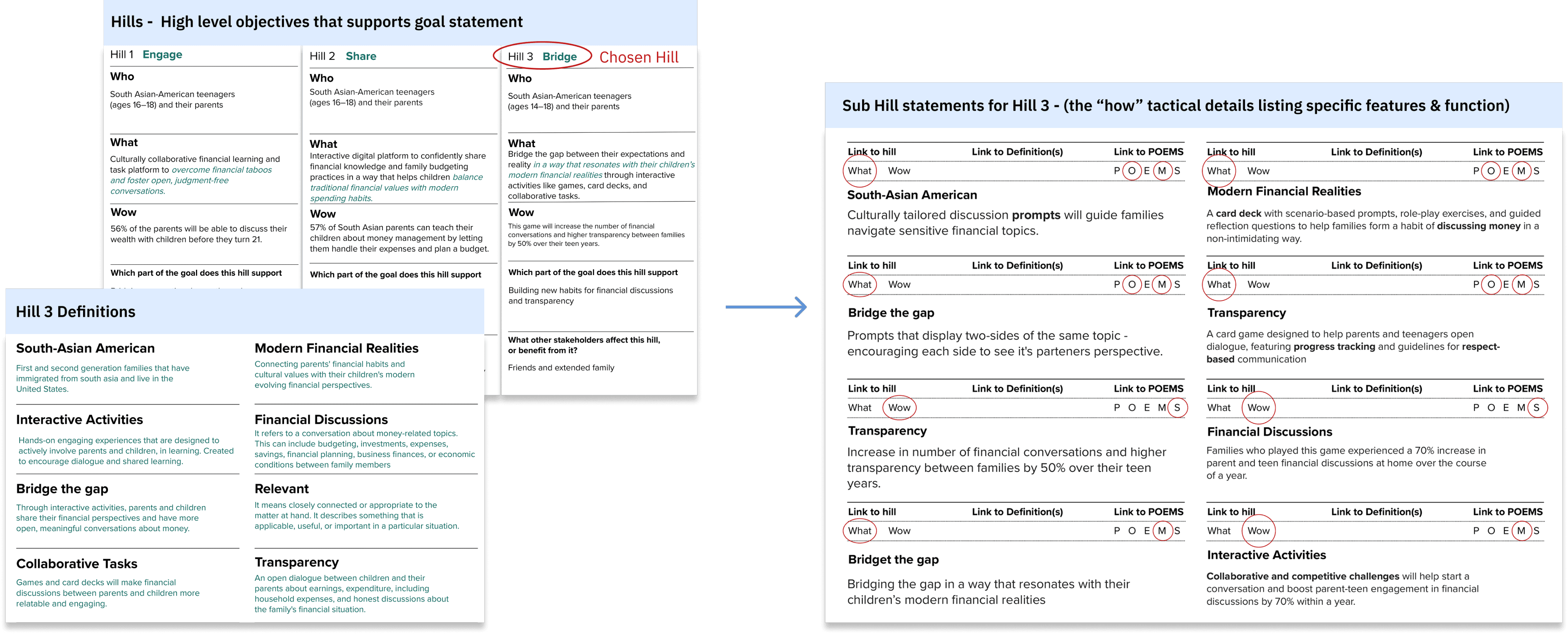
Using Agile Methodologies we broke down our high level goal statement into smaller objectives
We implemented IBM’s Hills and Sub-Hills framework to break down our goals into manageable parts. This decomposition exercise gave us clarity and helped us define our MVP.

High Level Strategy
Smaller
objectives
How do we put our vision into words?
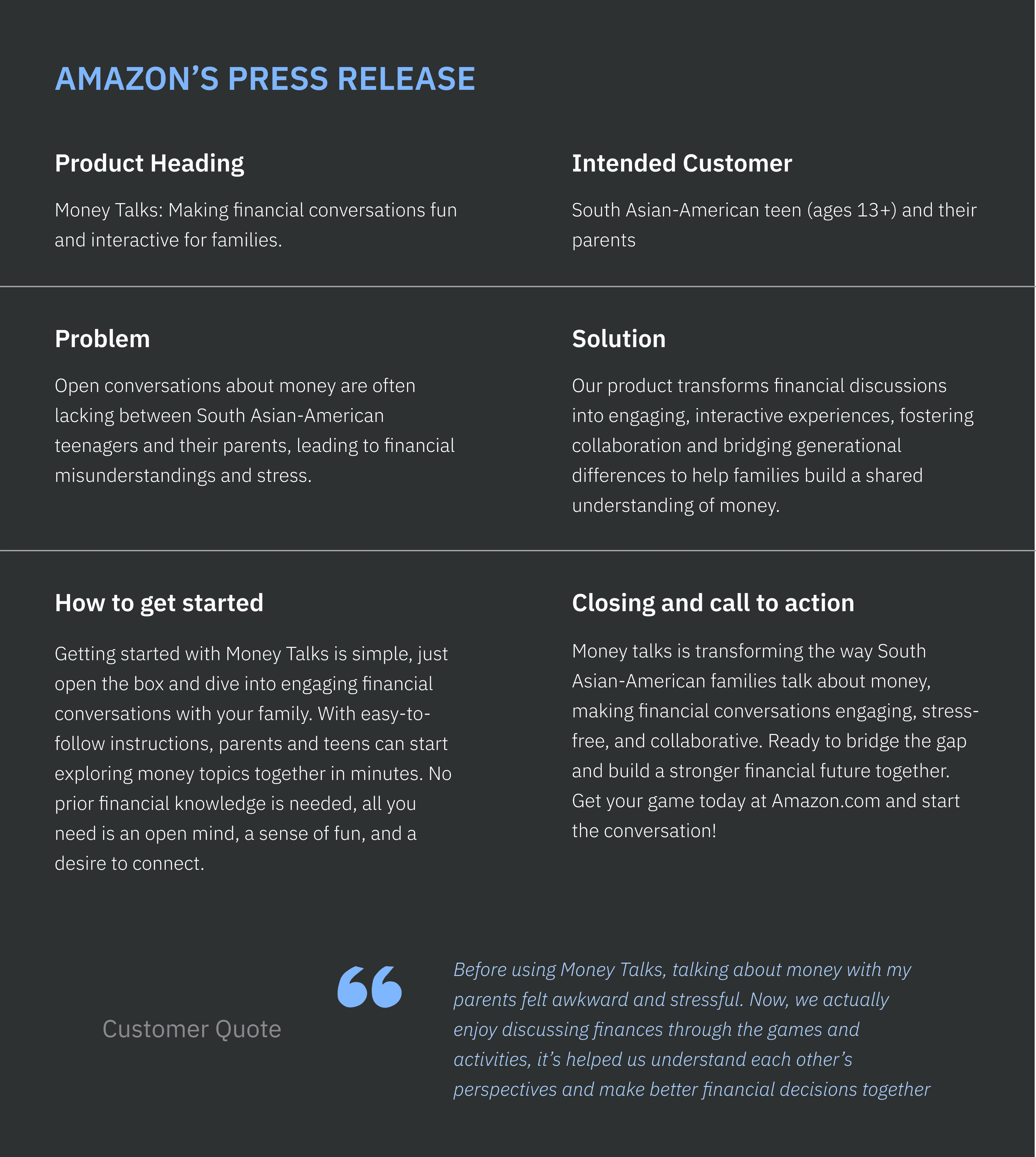
We crafted a press release that served as a strategic guide as we moved into building our game.
We worked backwards, organizing our research, ideas, opportunities, and challenges into words in a structured way that gave us a clear direction and kept our team aligned with the value we aimed to create for parents and teens through our game.

Amazon Press
Release
From digital interaction
To physical interaction
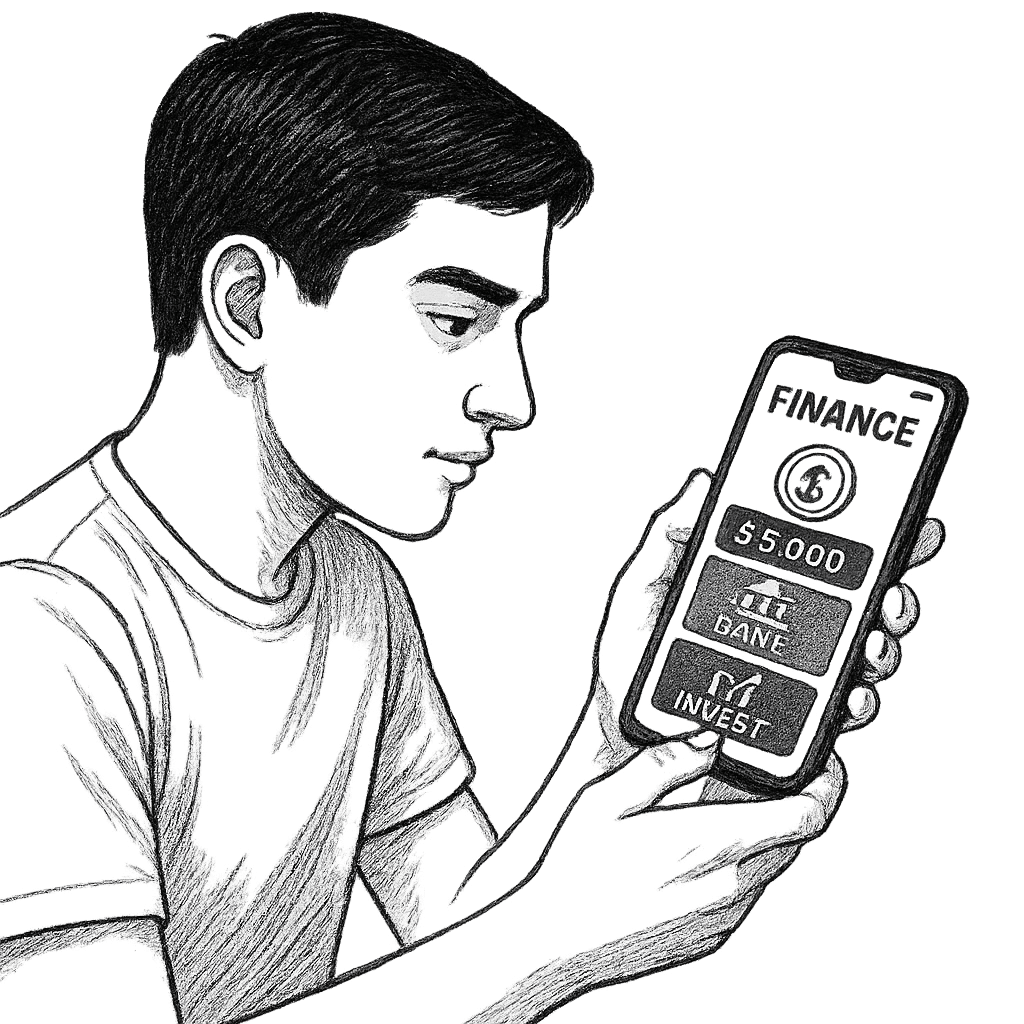

A pivot towards board game
Our initial ideas focused on creating digital tools, but research showed that screens often made money conversations feel distant and impersonal. In contrast, physical play brought families together, encouraging eye contact, laughter, and shared stories that built trust and openness. These insights inspired us to pivot toward a board game format, making financial discussions feel more organic, safe, and collaborative.
What does a typical journey of a parent and teen interacting with Money talks game looked like?

Money Talks
Candid cards for curious convsersations
$
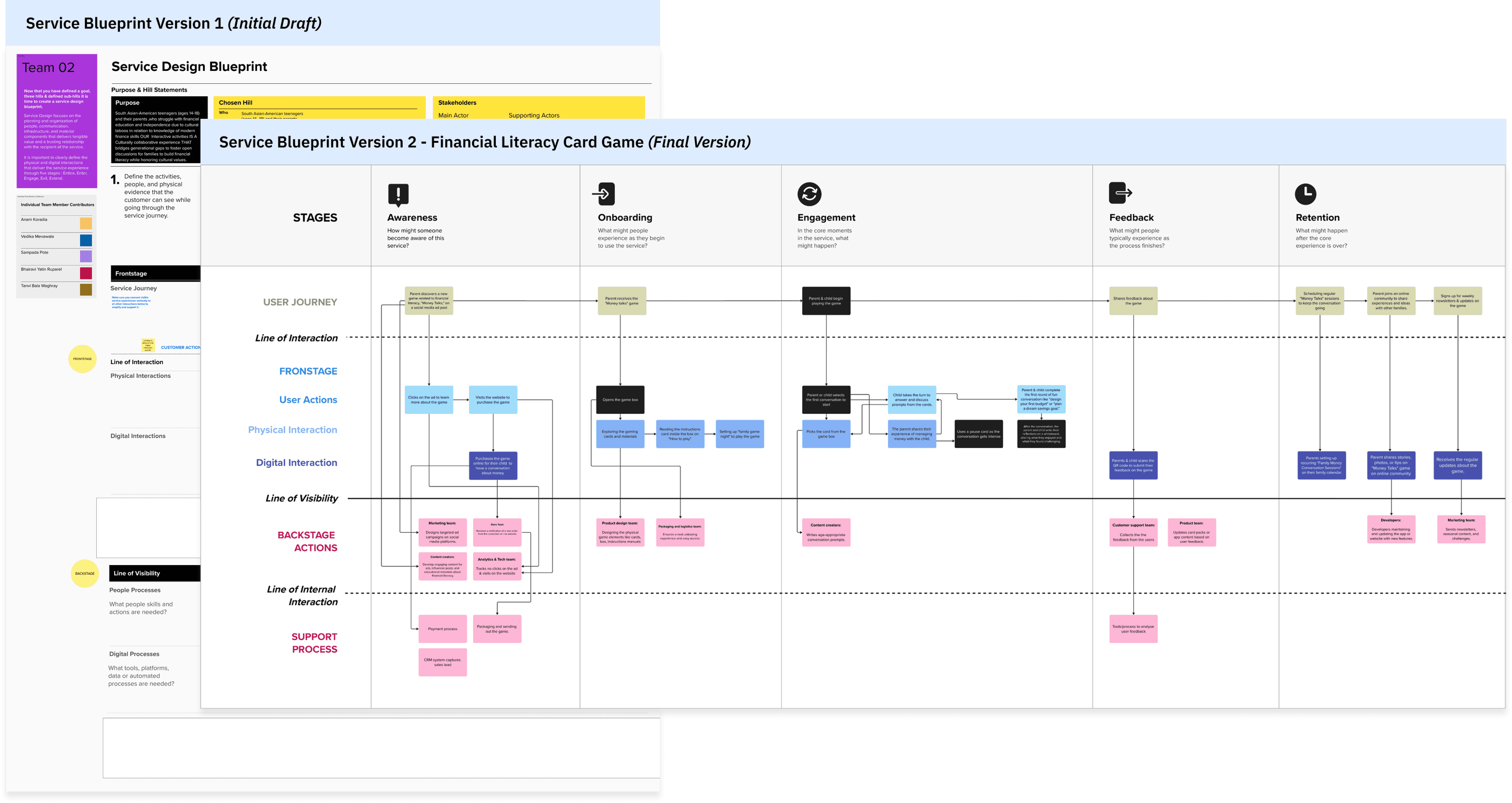
Service blueprint allowed us to visualise how our game would be delivered to parents & teens.
As a team member, I took ownership of the service blueprint, mapping the complete journey of how parents and teens engaged with the Money Talk card game, from discovery to the ongoing conversations that followed gameplay. Each user step was outlined along with the people, tools, and processes that supported it.
The journey was divided into five key stages: Awareness, Onboarding, Engagement, Feedback, and Retention.
Each stage highlighted both front-stage interactions (what users saw and did), back-stage efforts (the teams and systems that made the experience possible) and support processes (tools, data flows, and payment systems) that sustain and connect the entire service ecosystem.
It was time to put our vision into action.
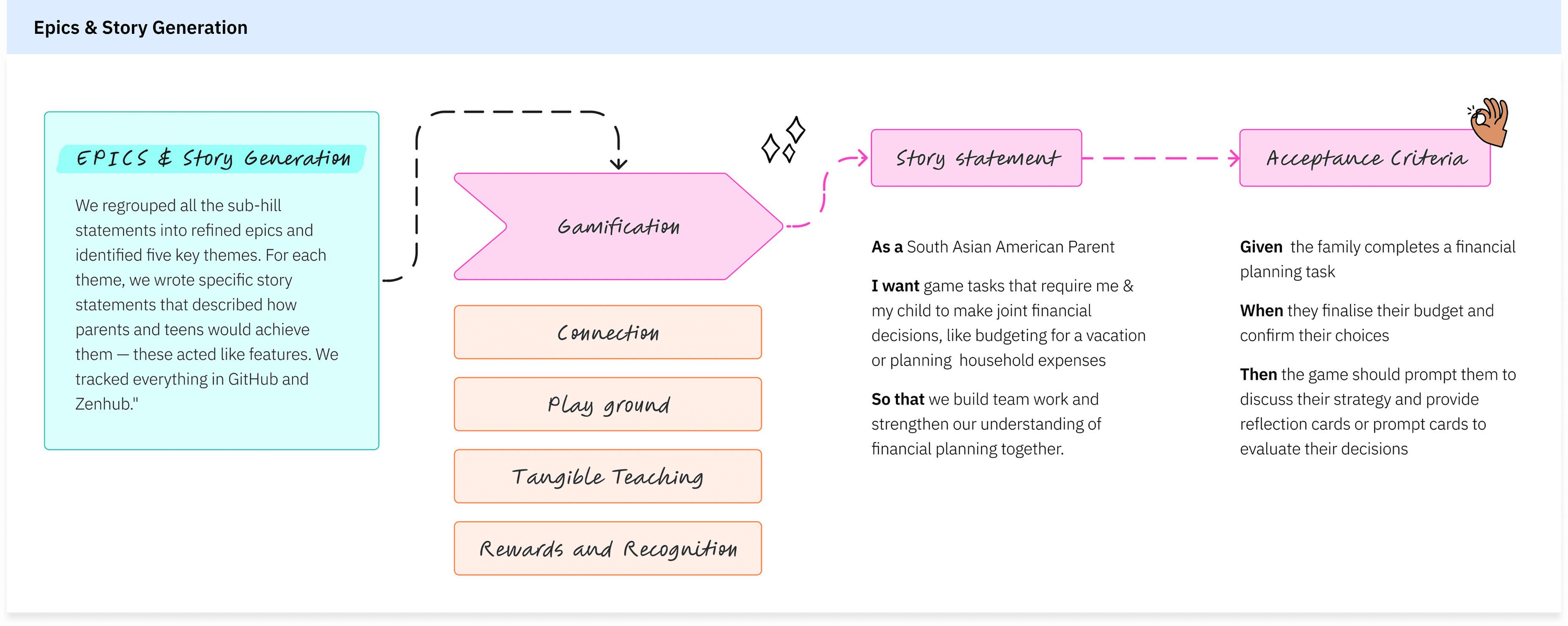
By creating epics and stories, we identified the main themes and features of our game.
For our team, epics represented the overarching themes that defined the game experience. Under each epic, we crafted user story statements to capture what parents and teens wanted and why it mattered. We also defined acceptance criteria to outline how each goal would be achieved in the final experience.
One of our key epics, “Gamification,” focused on designing interactive, hands-on gameplay that encouraged parents and teens to connect through shared activities—making financial learning fun, engaging, and truly collaborative.
$
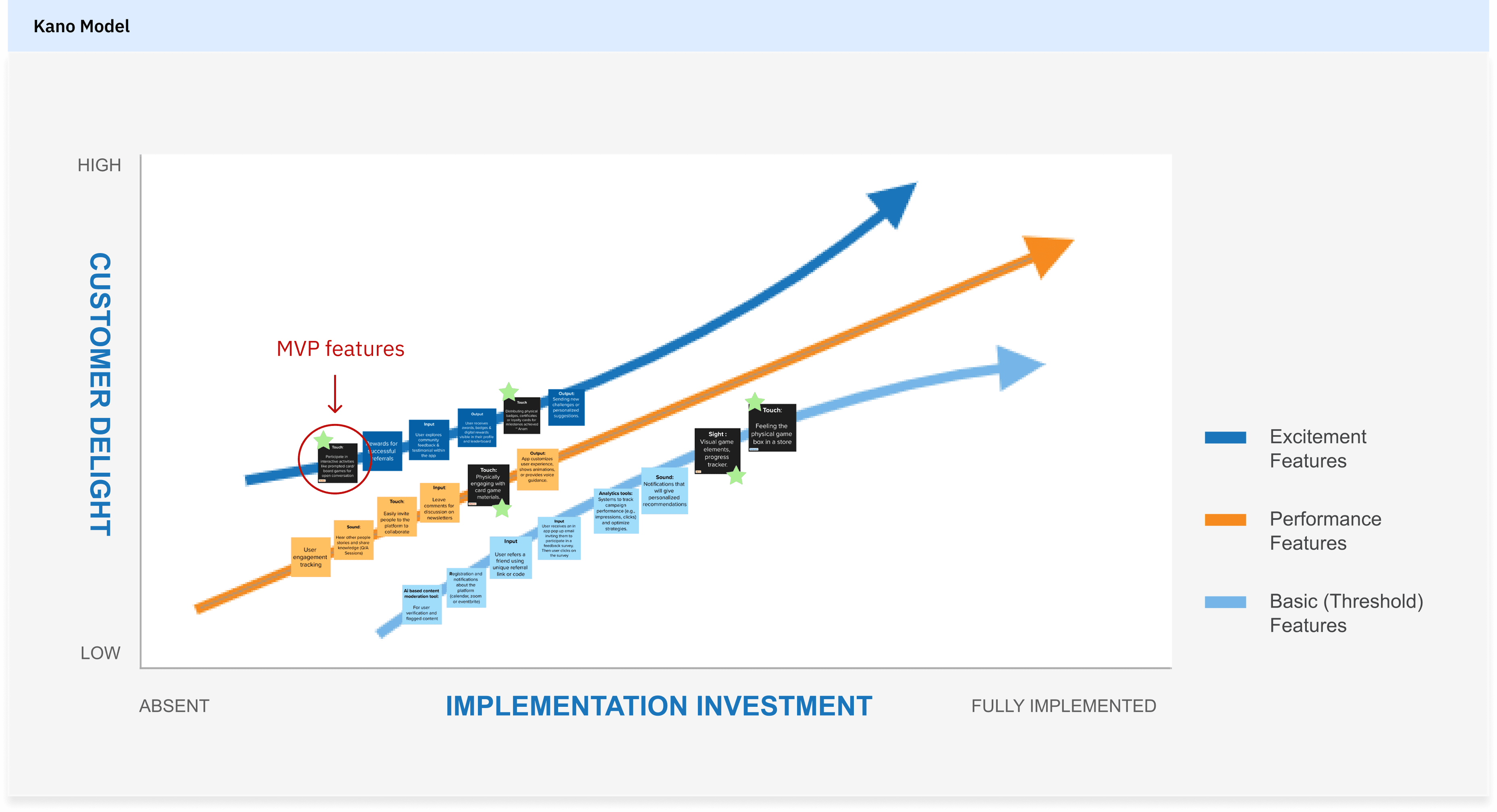
Through Kano Model we
prioritised the features we
wanted to include in our MVP.
We grouped all our features into three categories: basic, performance & excitement features
But we didn’t want to build the whole game all at once.

Touch
Participate in interactive activities like prompted card/board games for open conversation

Touch
Distributing physical badges, certificates or loyalty cards for milestones achieved

Touch
Physically engaging with card game materials.
Sight
Visual game elements, progress tracker.

Touch
Feeling the physical game box in a store
By visually sequencing each step of interaction, it allowed our team to identify key emotional moments where trust, transparency, and shared learning emerged.
Through this process, we could envision how Money Talks would fit naturally into family dynamics showing not just what users do, but how they feel while doing it. Storyboarding helped us prototype emotions before building features, enabling us to align design decisions with the real human experiences our game aimed to foster.
The storyboard was instrumental in mapping the emotional journey of both parents and teens, from confusion and hesitation to confidence and connection.
Parents express worry about their child’s ability to handle money, believing he is too young and inexperienced to manage it responsibly.
Frame 1: Parents concerned

I agree, let your father manage it. Right now you’re too young.
Son, you are not yet responsible to handle your own money.
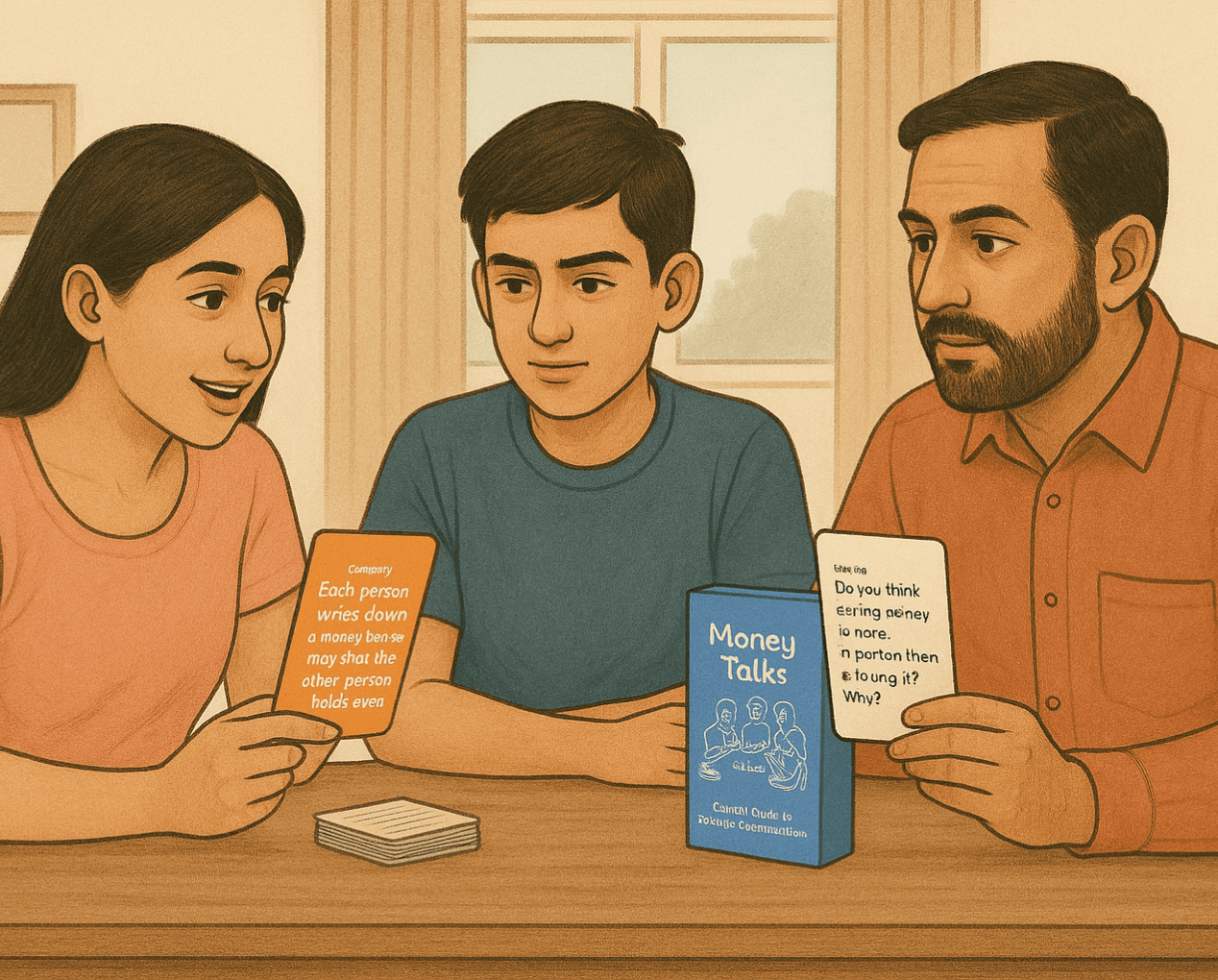
Frame 4: Shared Experience
At home, the family plays Money Talks together, using the game as a comfortable way to discuss money openly, fostering trust, understanding, and collaboration.
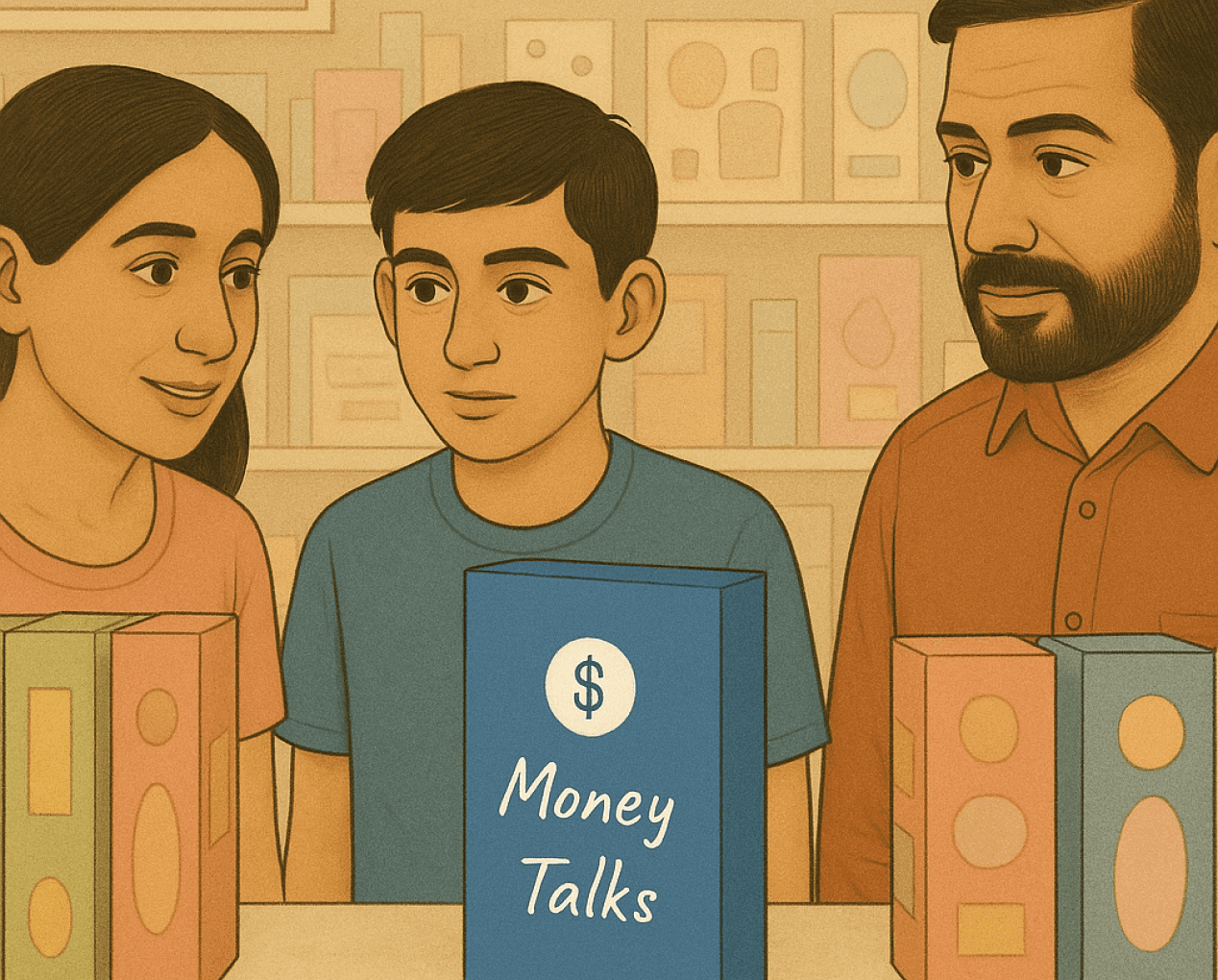
Frame 3: Discovery at the Store
During a store visit, the family spots the Money Talks game. The teen’s curiosity is piqued, and the parents take interest, sensing it might help start meaningful conversations.
Frame 2: Private Reflection
Later, in a private conversation, the mother shares her uncertainty about how to guide their child, and the father admits he also struggles to explain financial matters clearly.

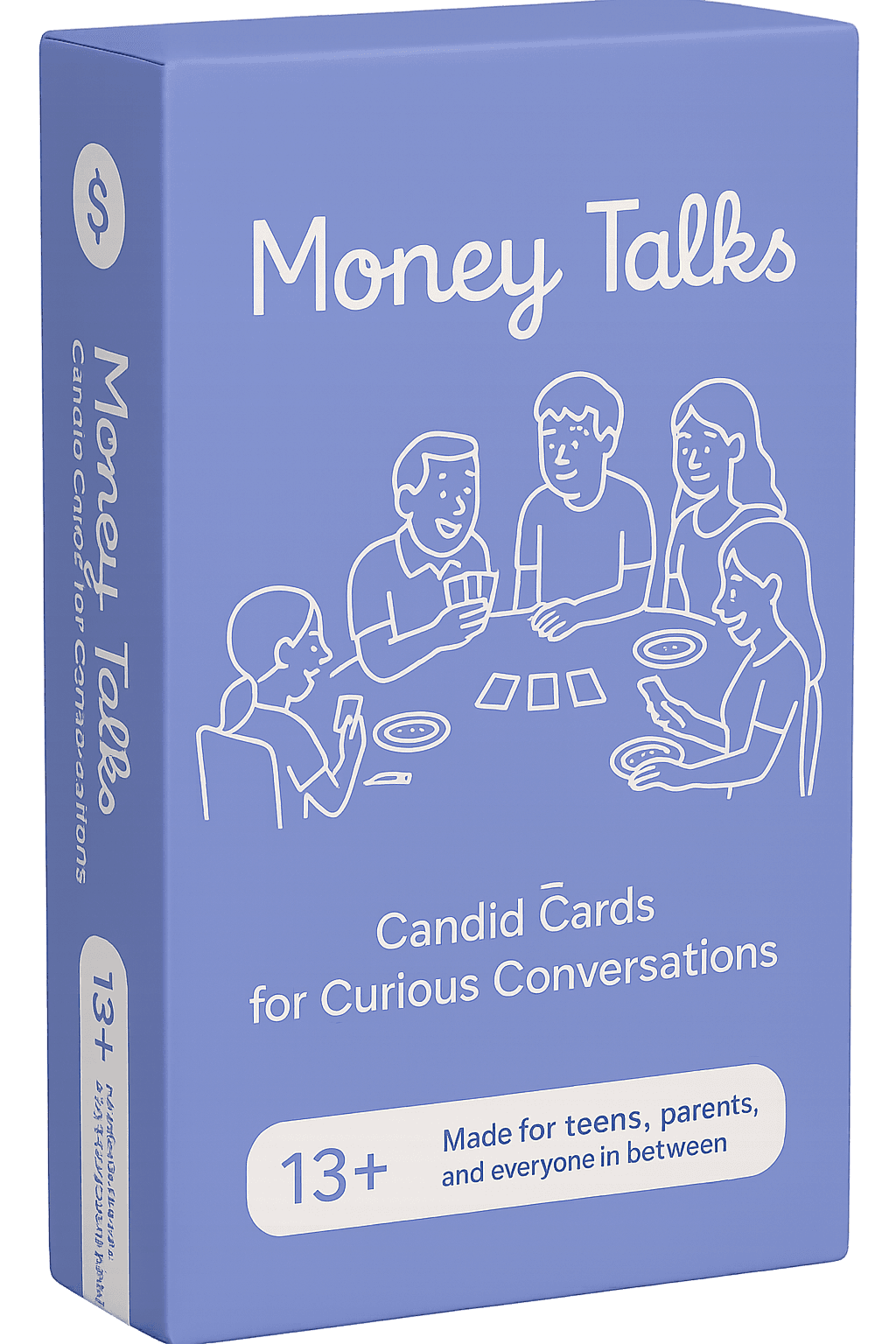
Introducing Money Talks
An interactive card game that helps families discuss money matters anytime, anywhere.
Making financial conversation more accessible
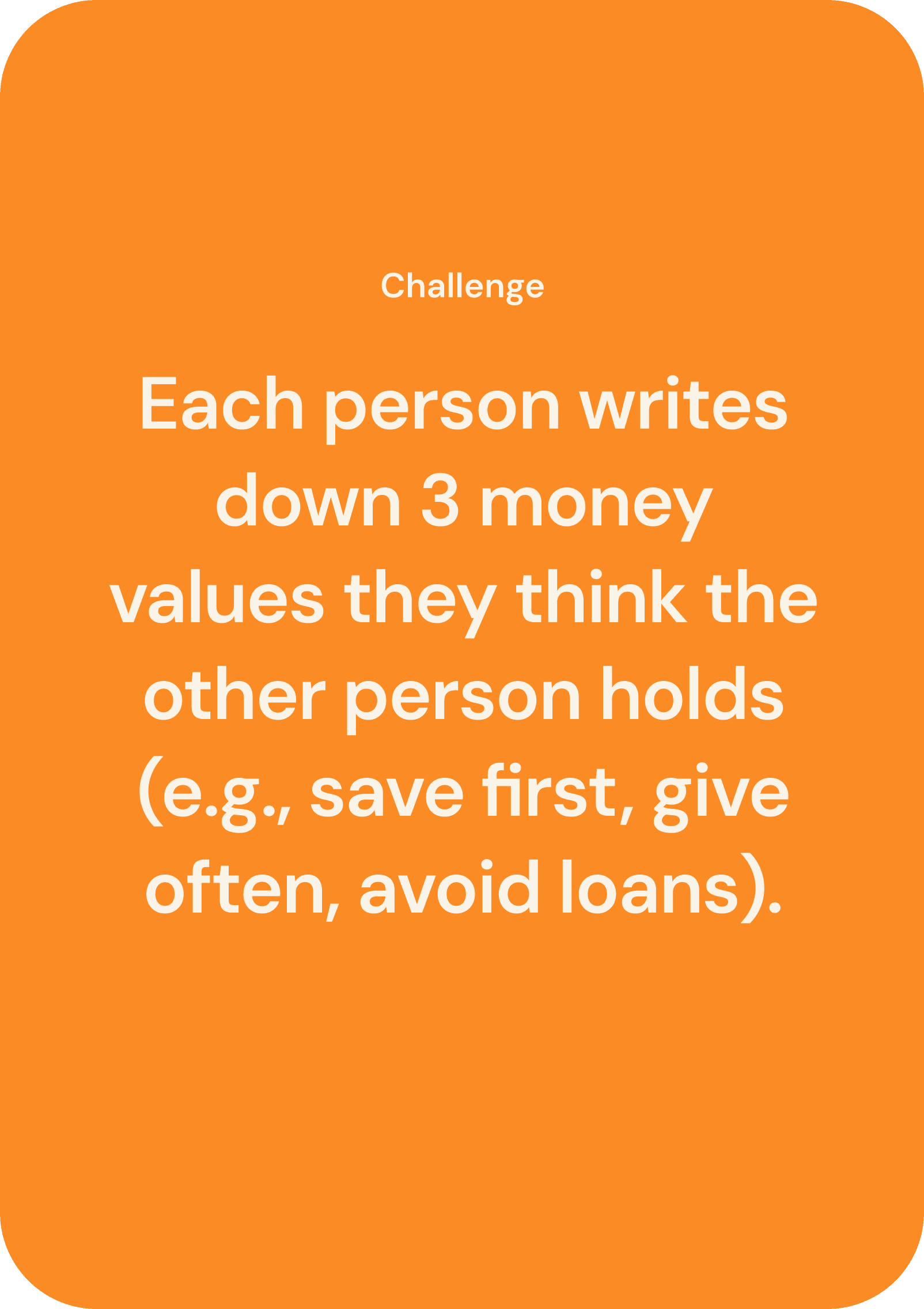
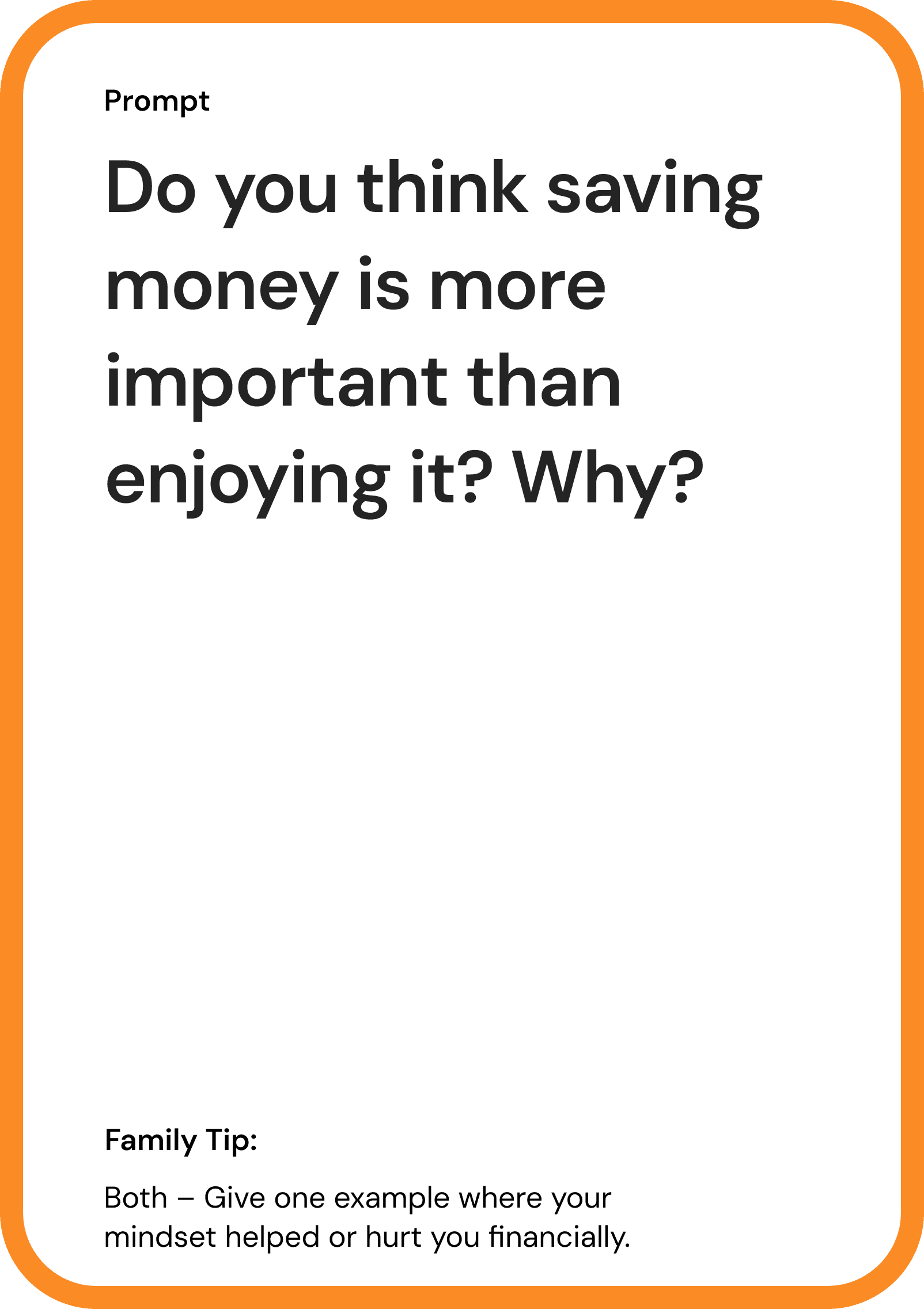
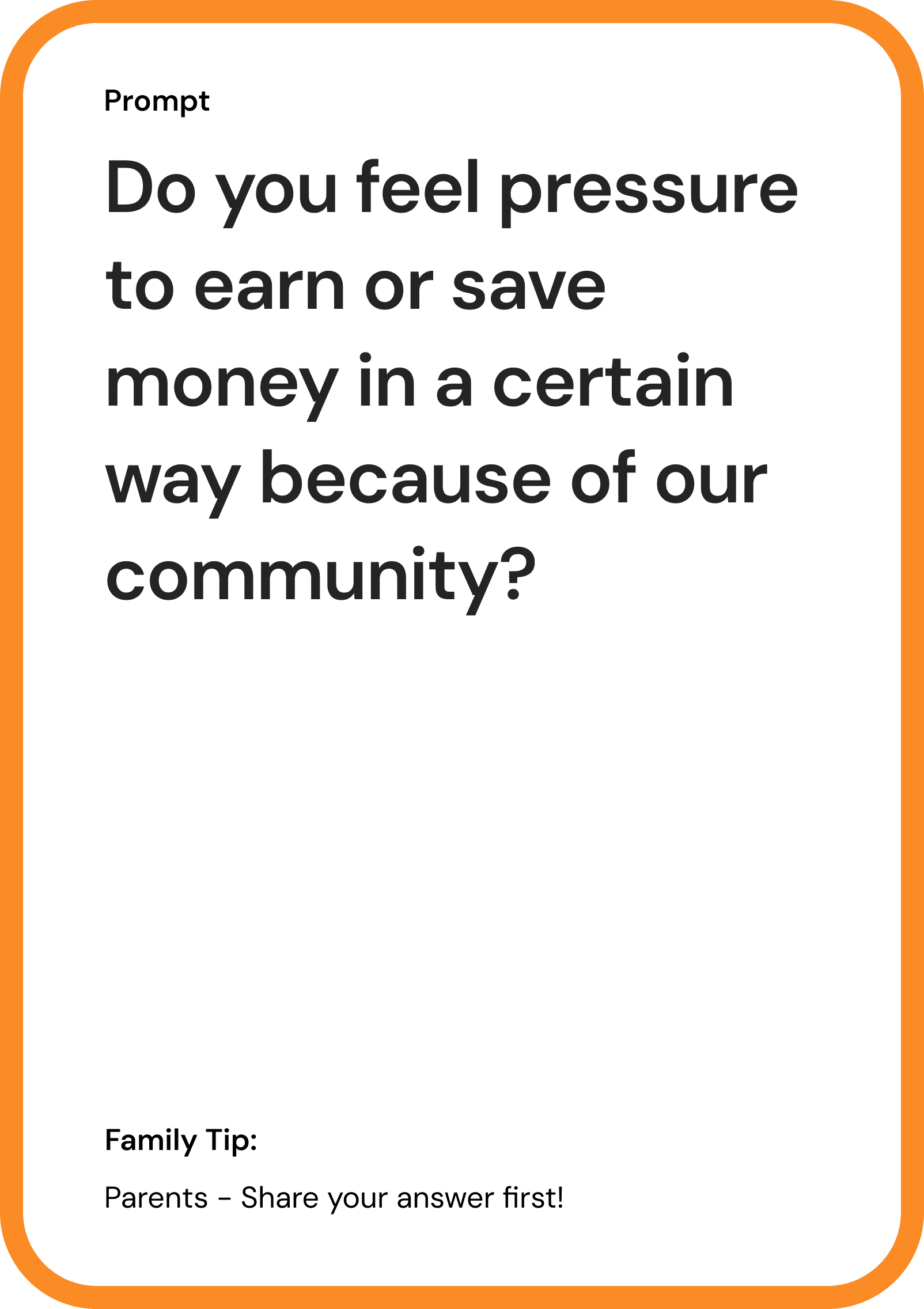
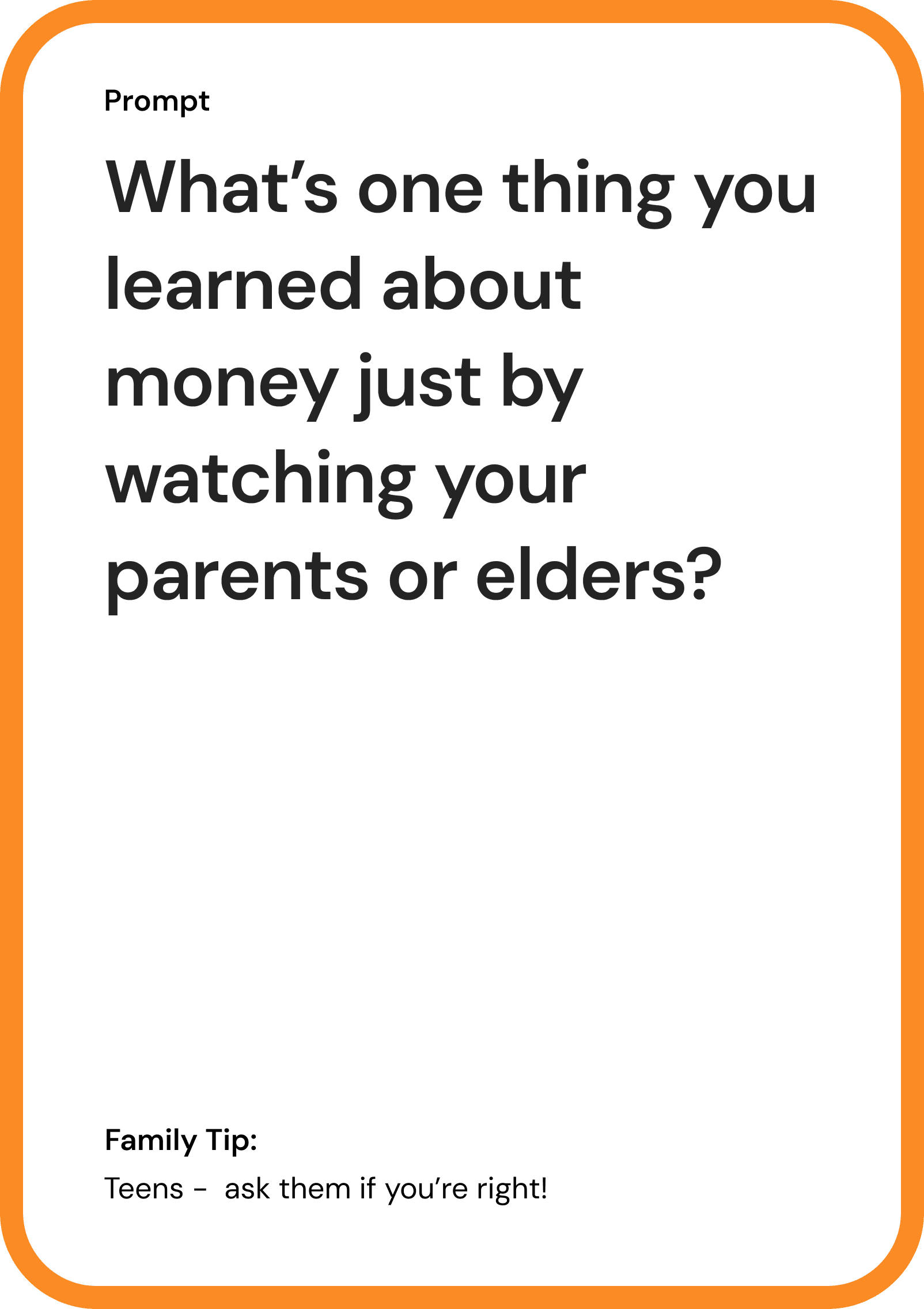
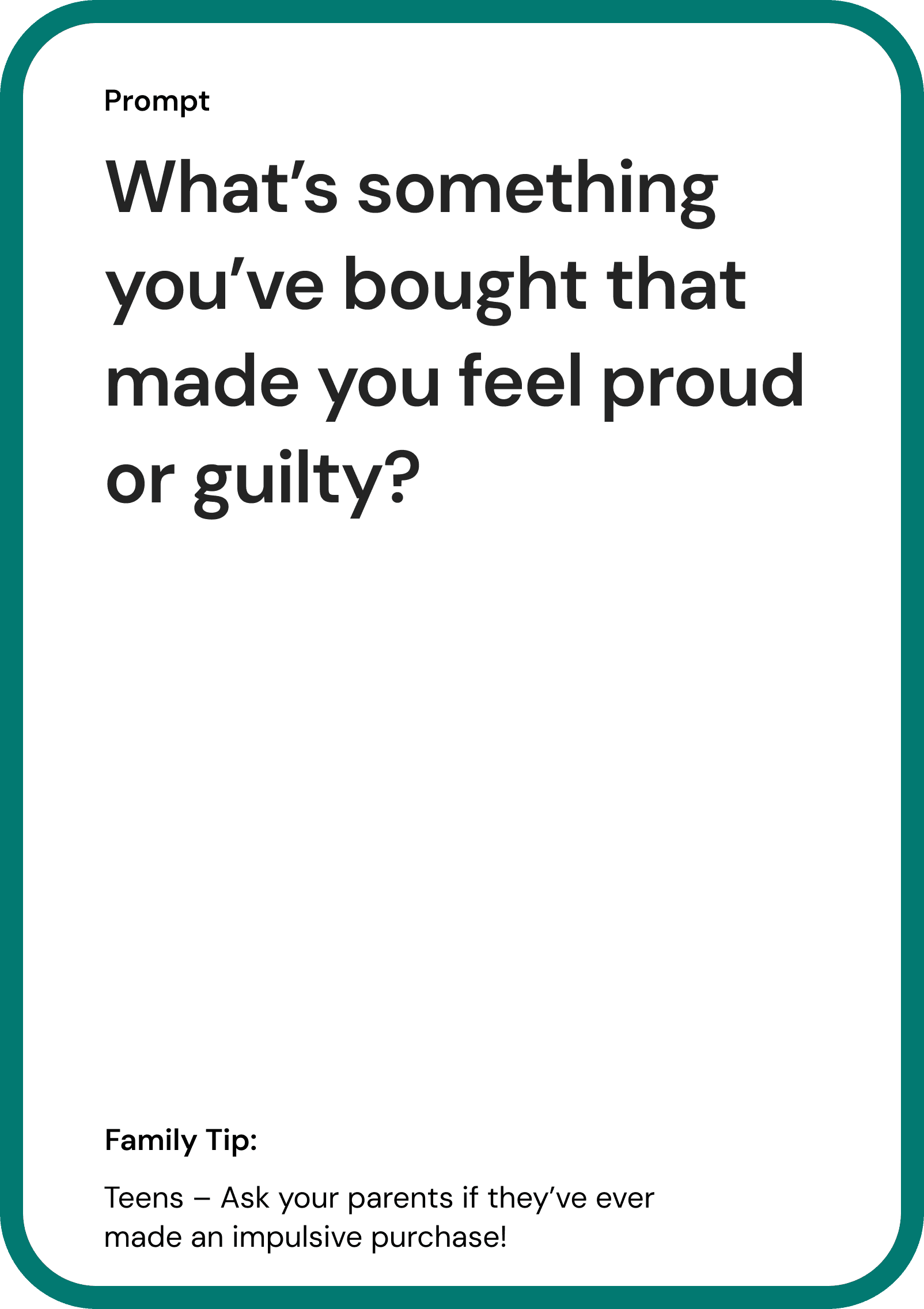
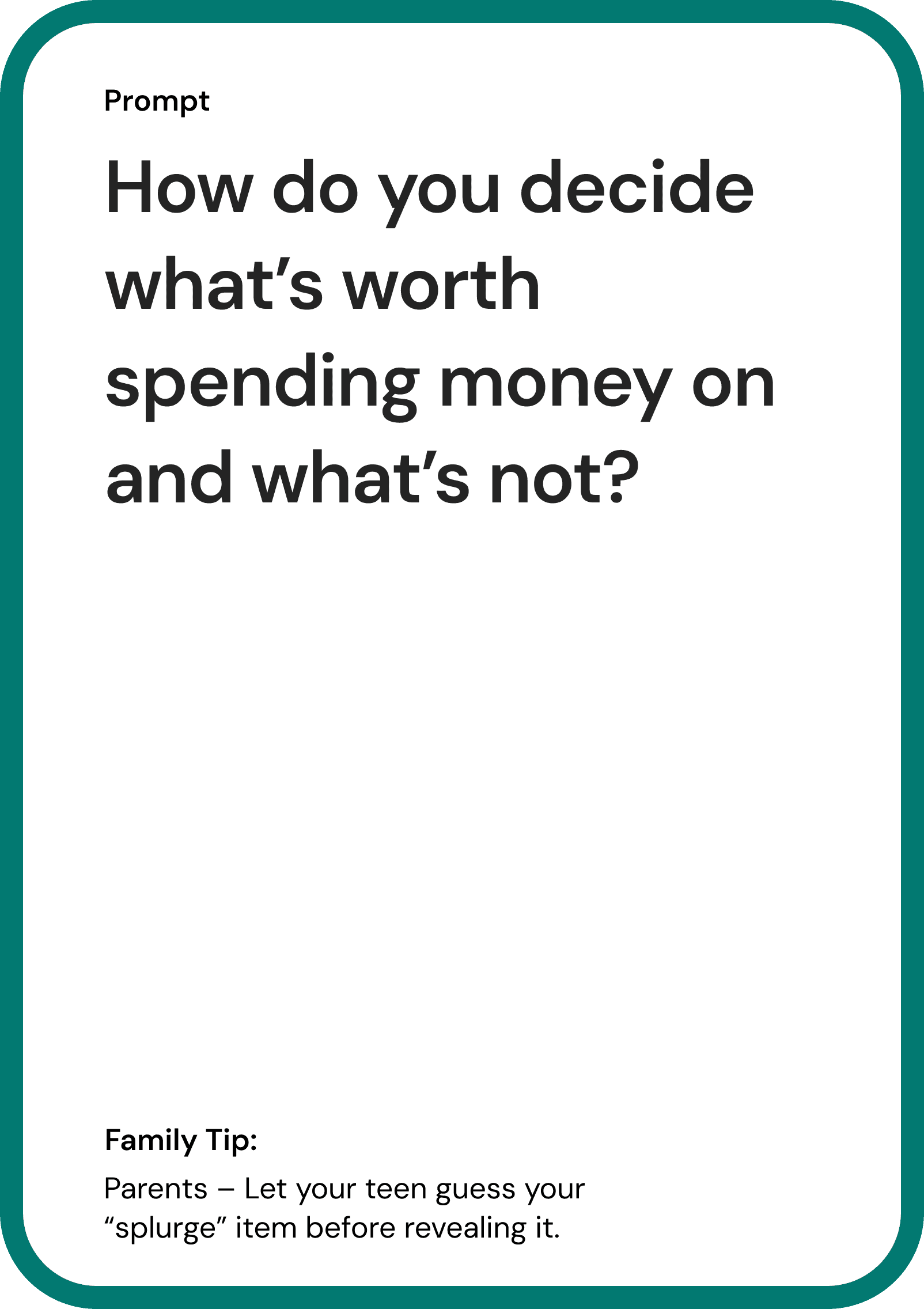
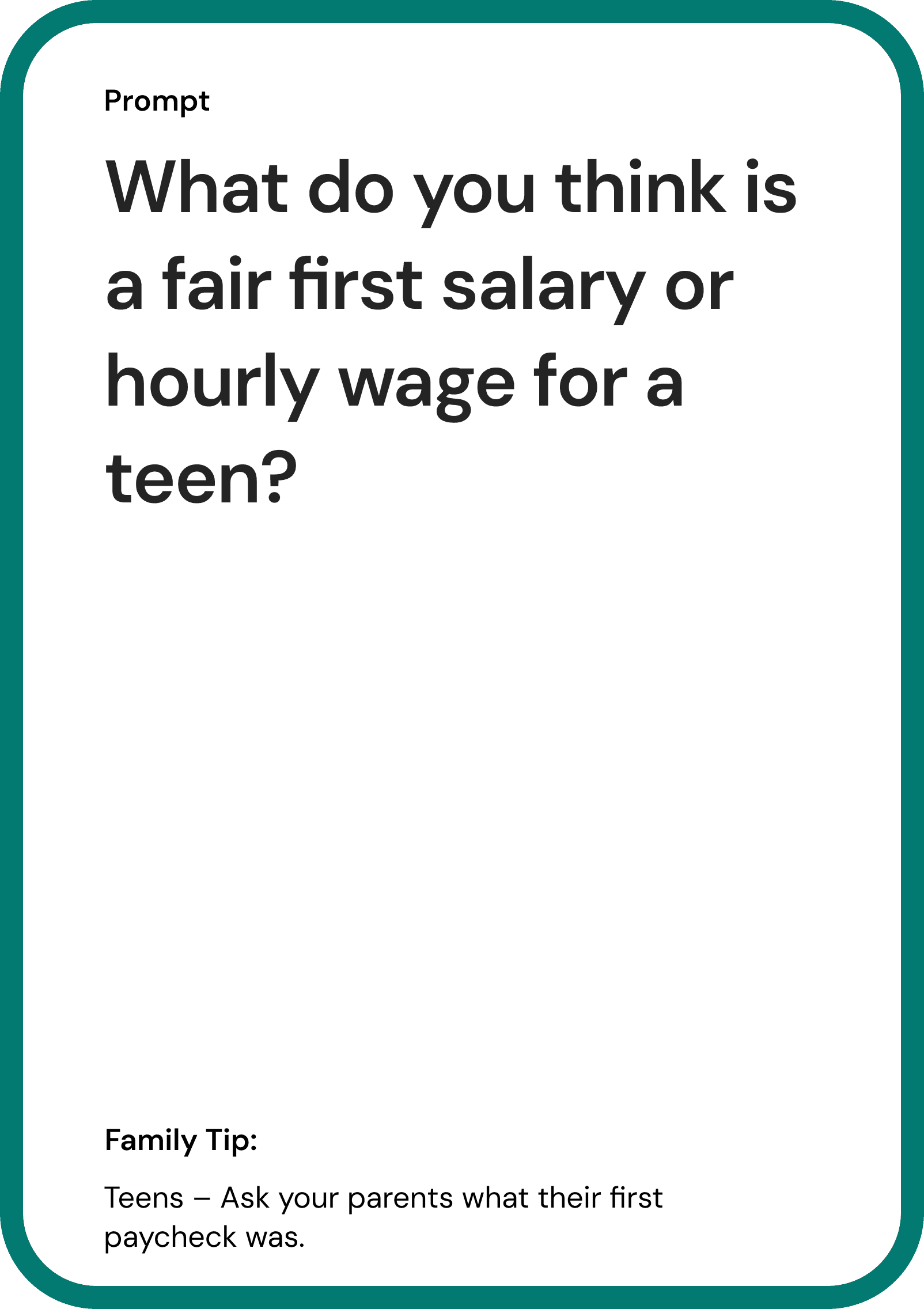
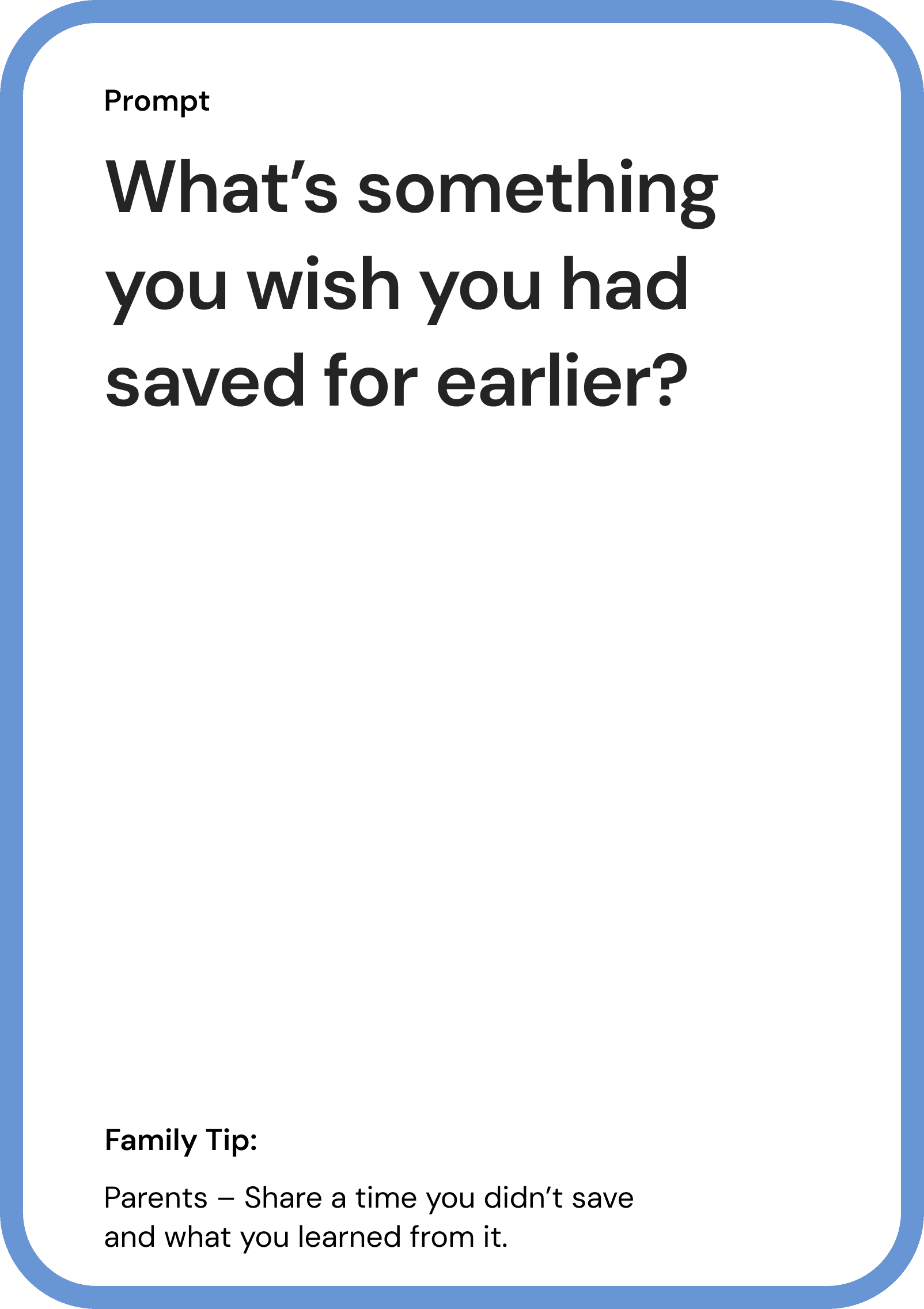
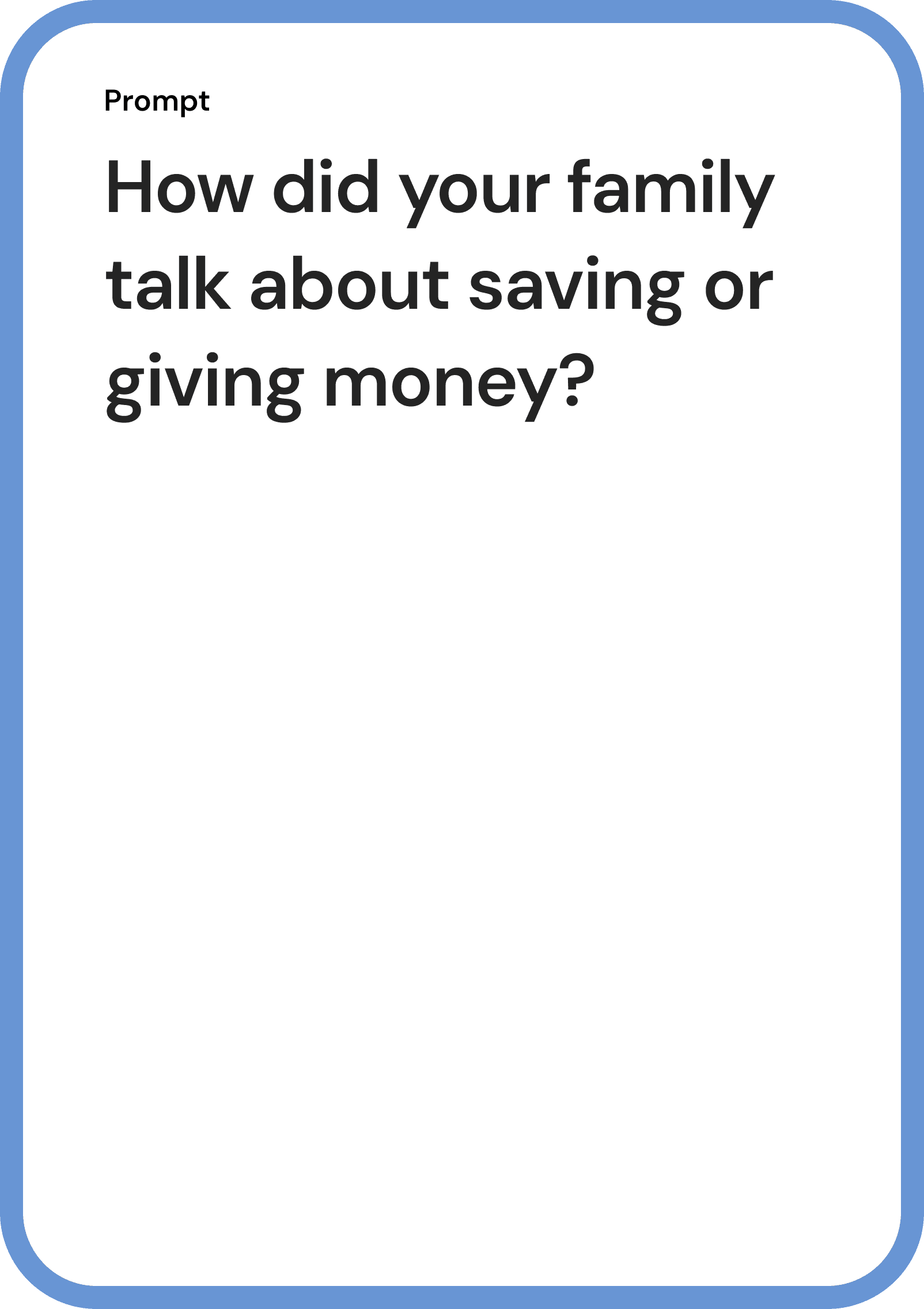
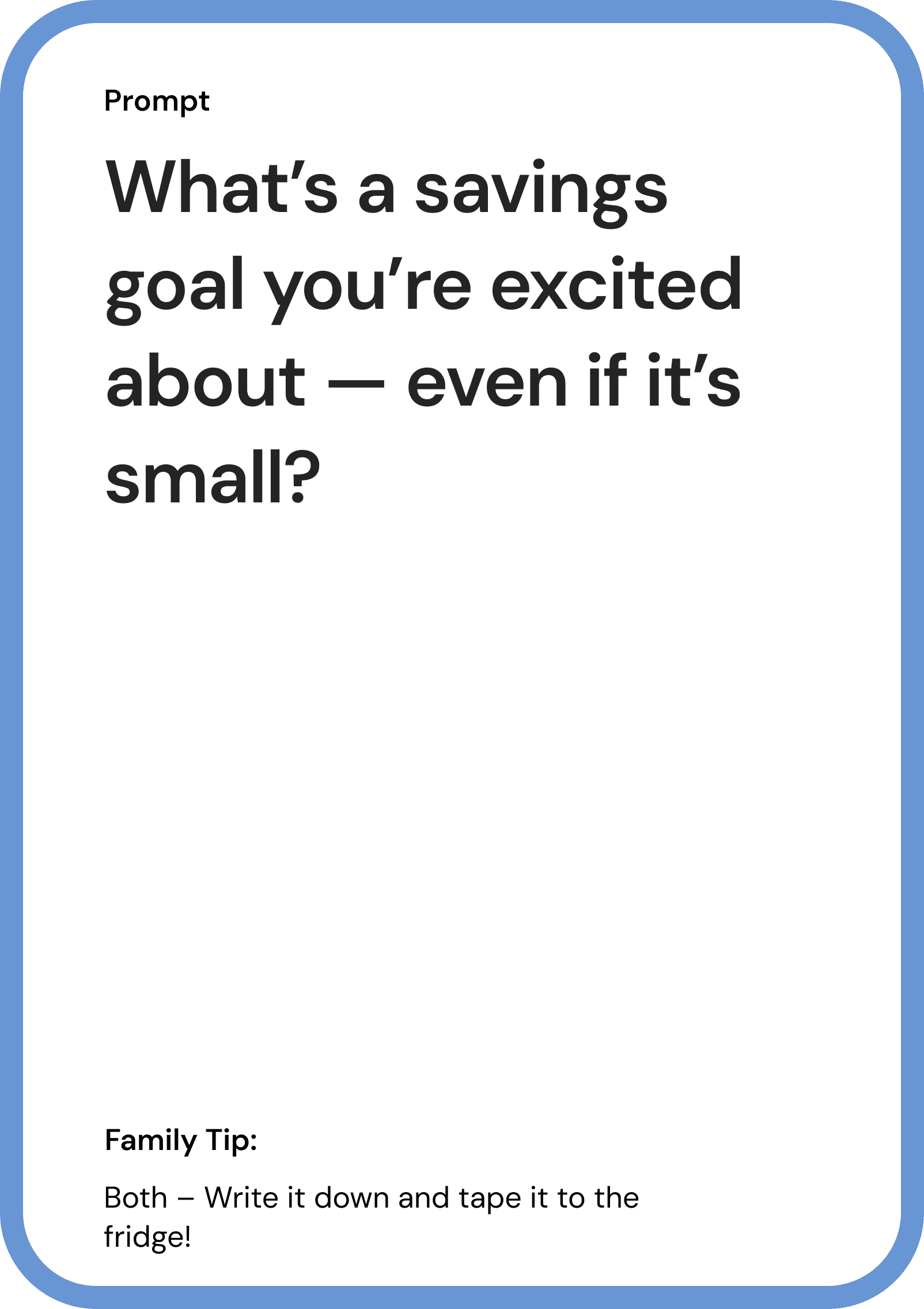
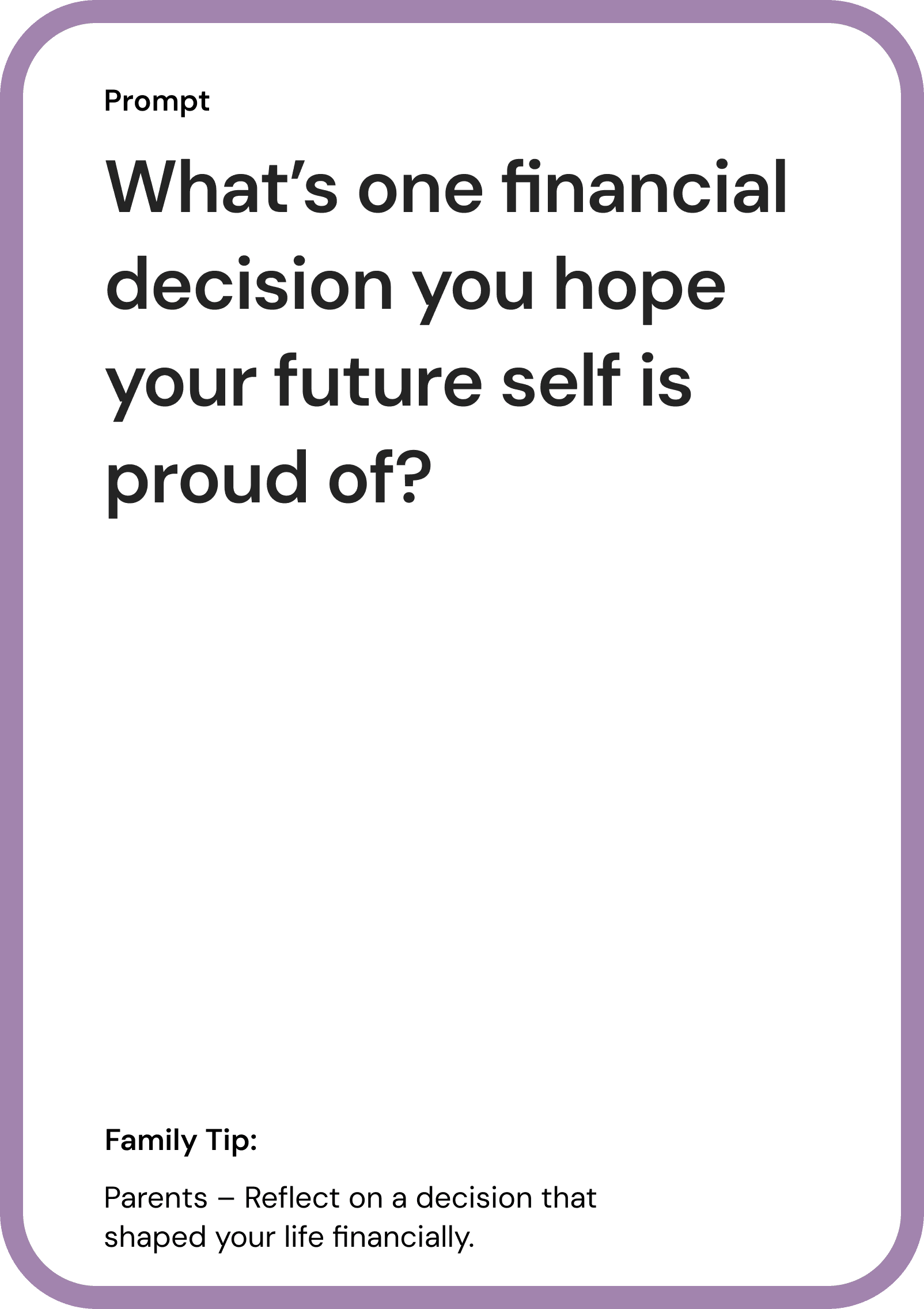
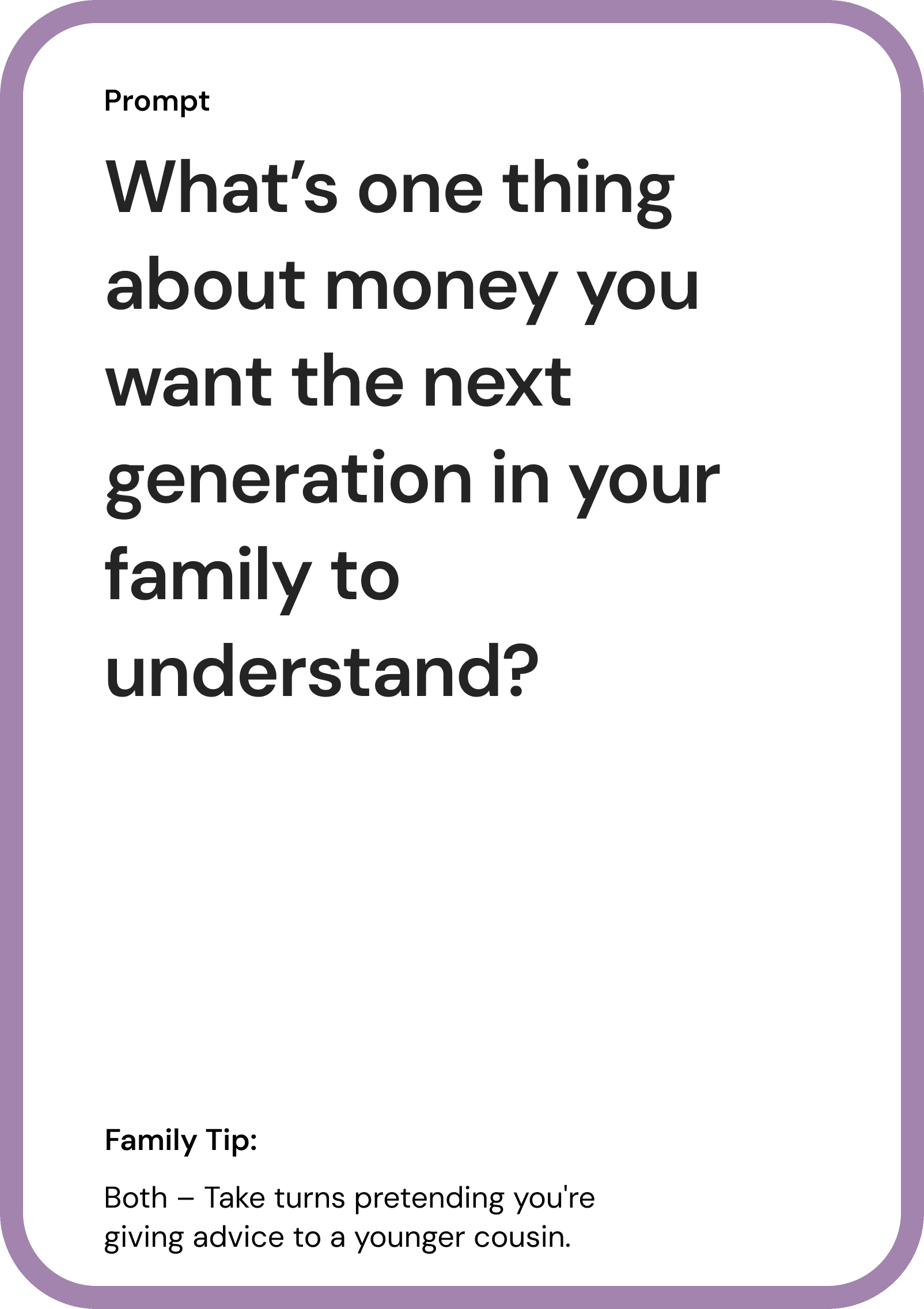
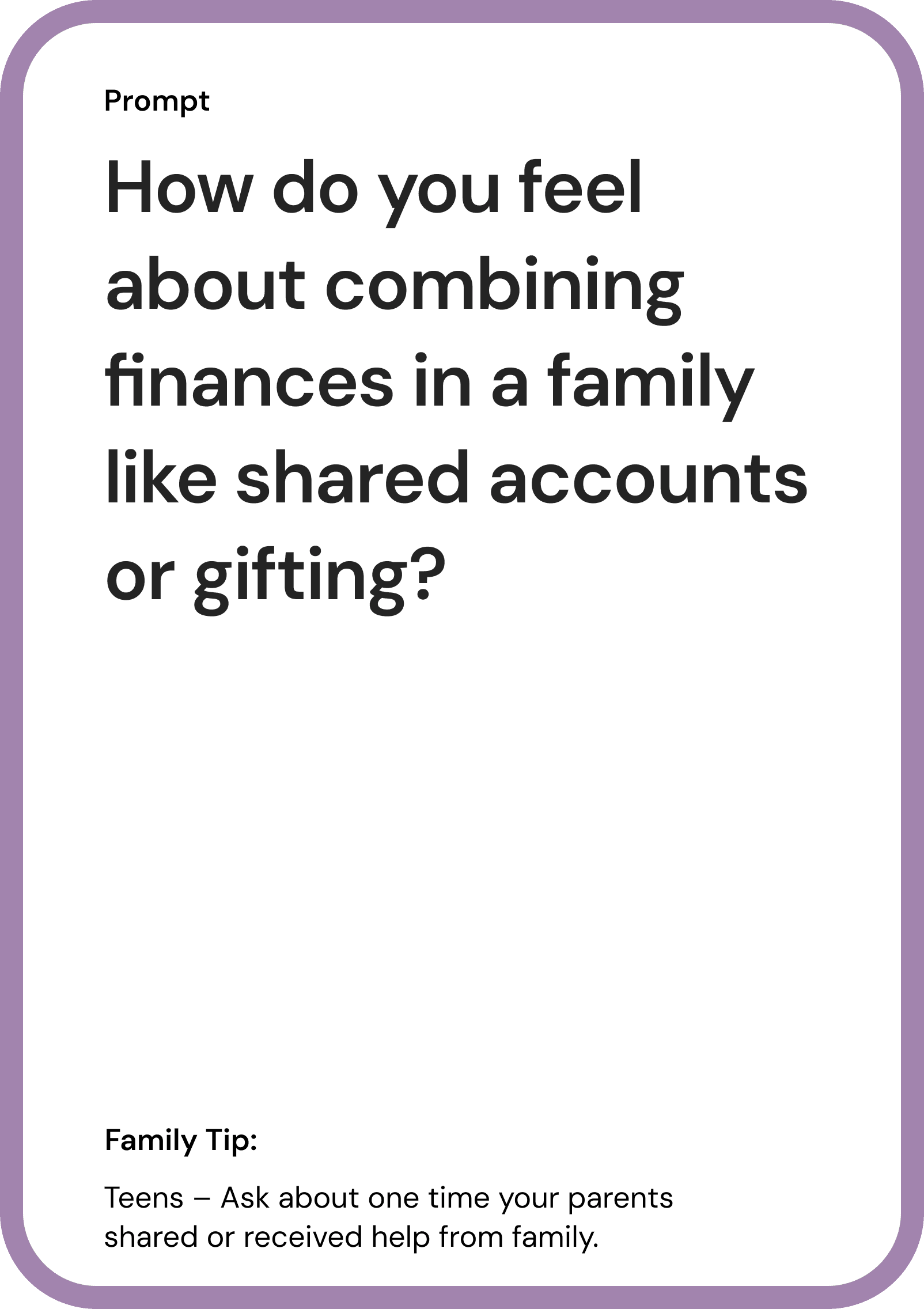
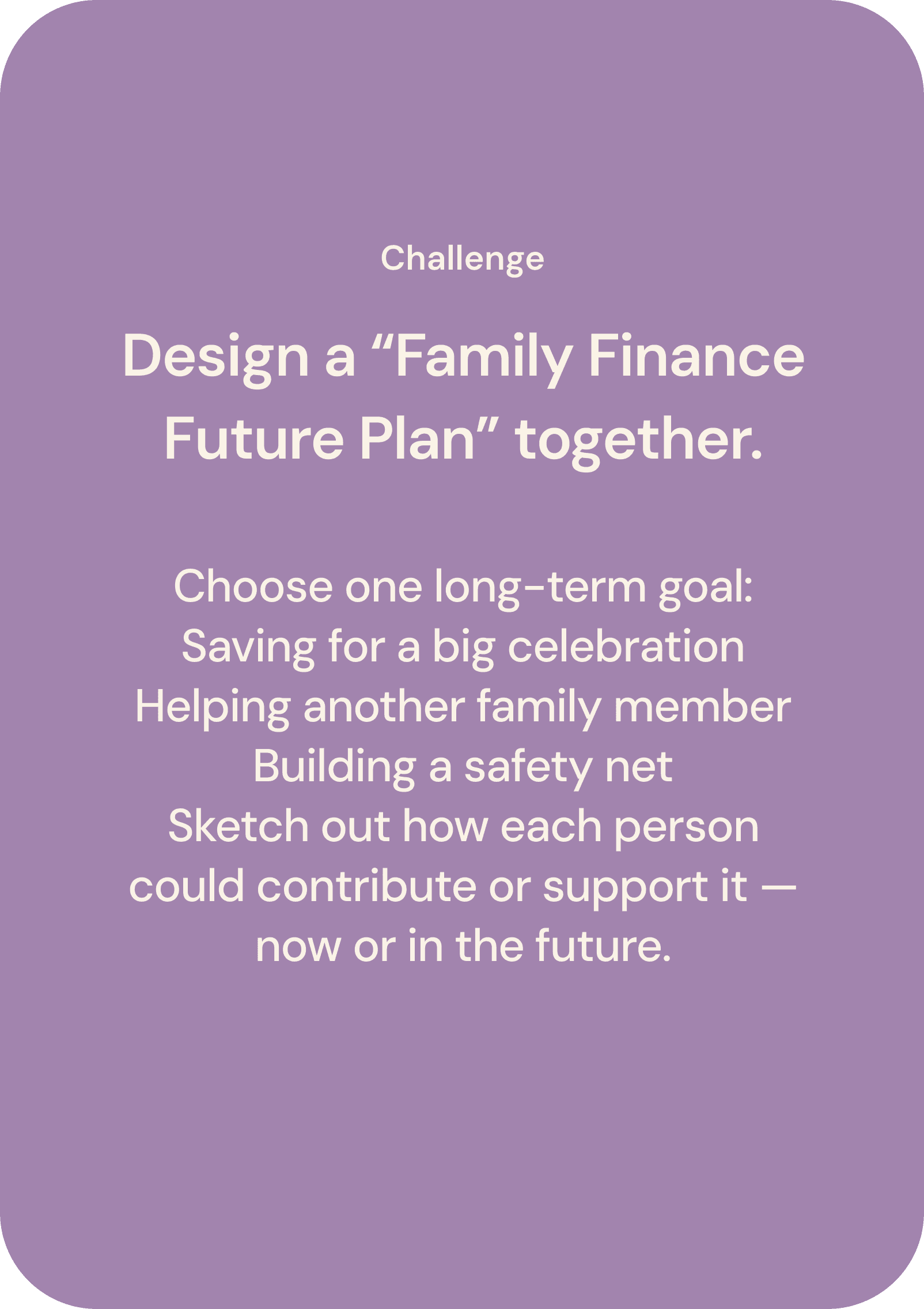
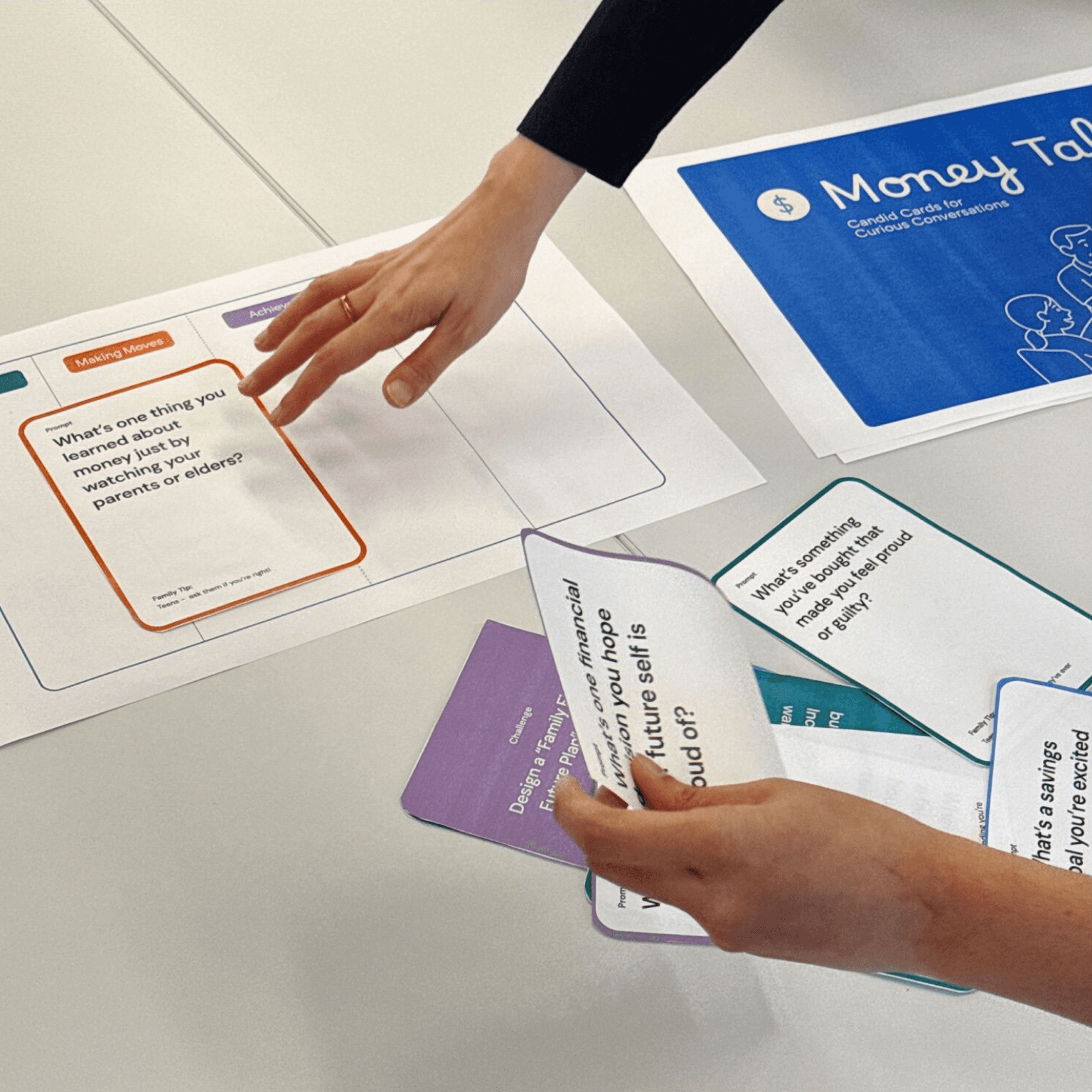
The deck has 4 themes, each with challenge cards, prompts, and tips to guide the conversations.




Money Mindset Theme
This is how we designed the Money Mindset theme cards. Each theme included a challenge card paired with supporting prompt cards, all crafted to spark meaningful conversations.
The colors and topics were intentionally varied to represent different aspects of money discussions and emotional dynamics around them.


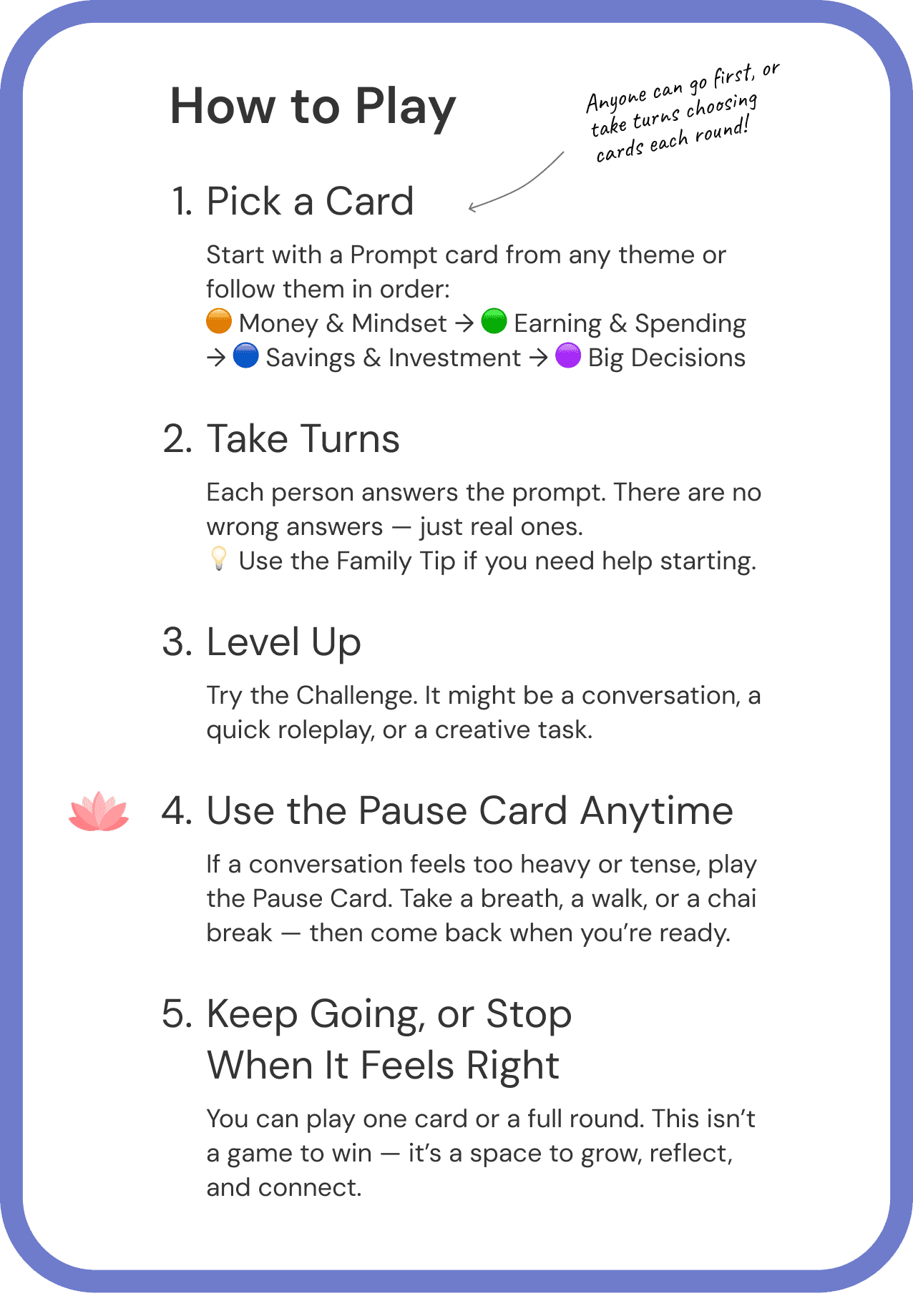
Instruction & Pause Cards
The deck also includes instruction cards that guide players step by step on how to play the game.
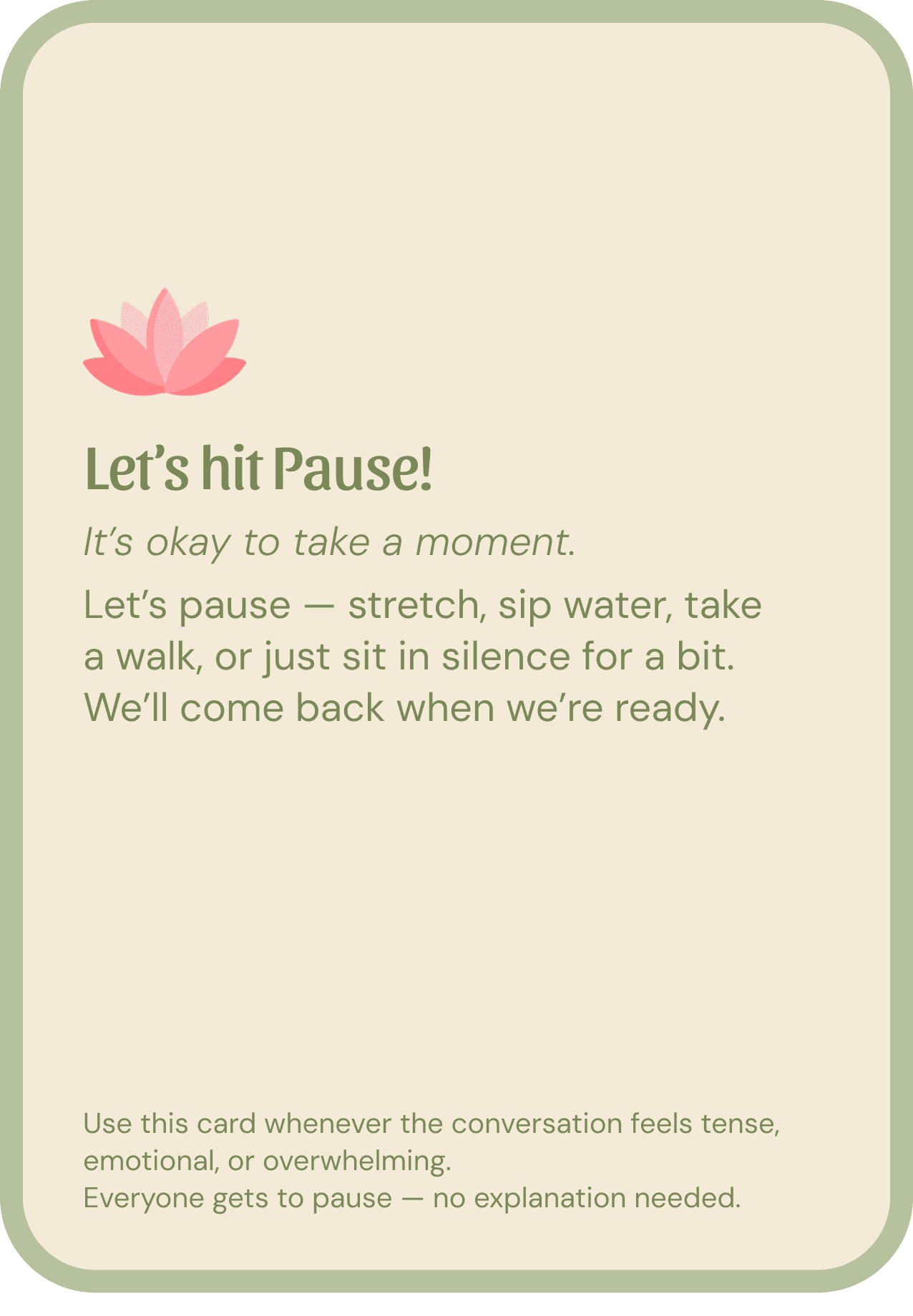
It also has a pause card, allowing either the teen or the parent to take a break during tense moments and revisit the conversation later in a calmer, more comfortable setting.
Achieved & Reflection Board
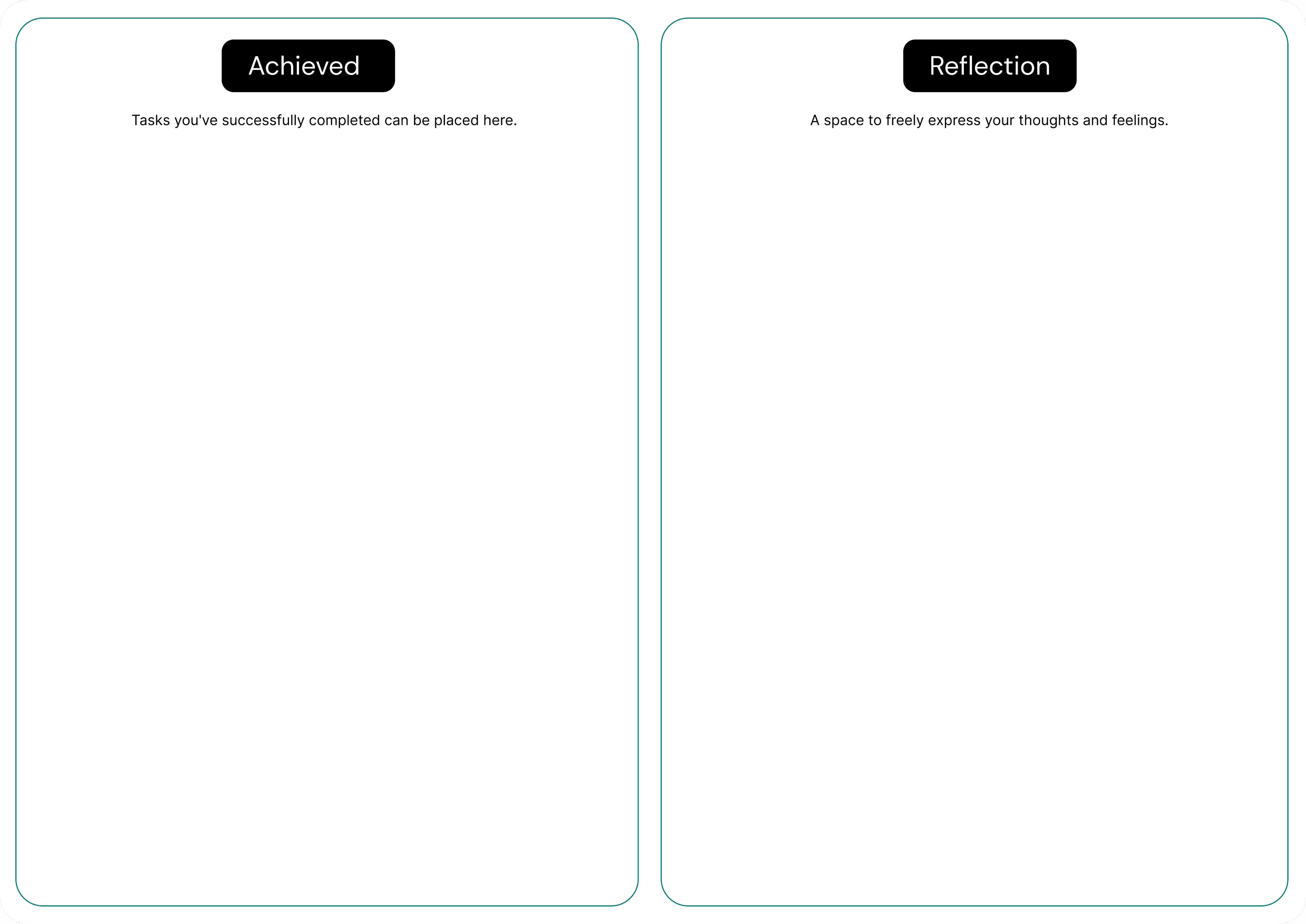
Players can use the “Achieved” section to record tasks or challenges they’ve successfully completed, creating a sense of accomplishment and progress.
The “Reflection” section offers space to freely express thoughts, emotions, or learnings from the experience.
This help players internalize lessons from each round and recognize how their money-related choices connect to personal values and confidence.
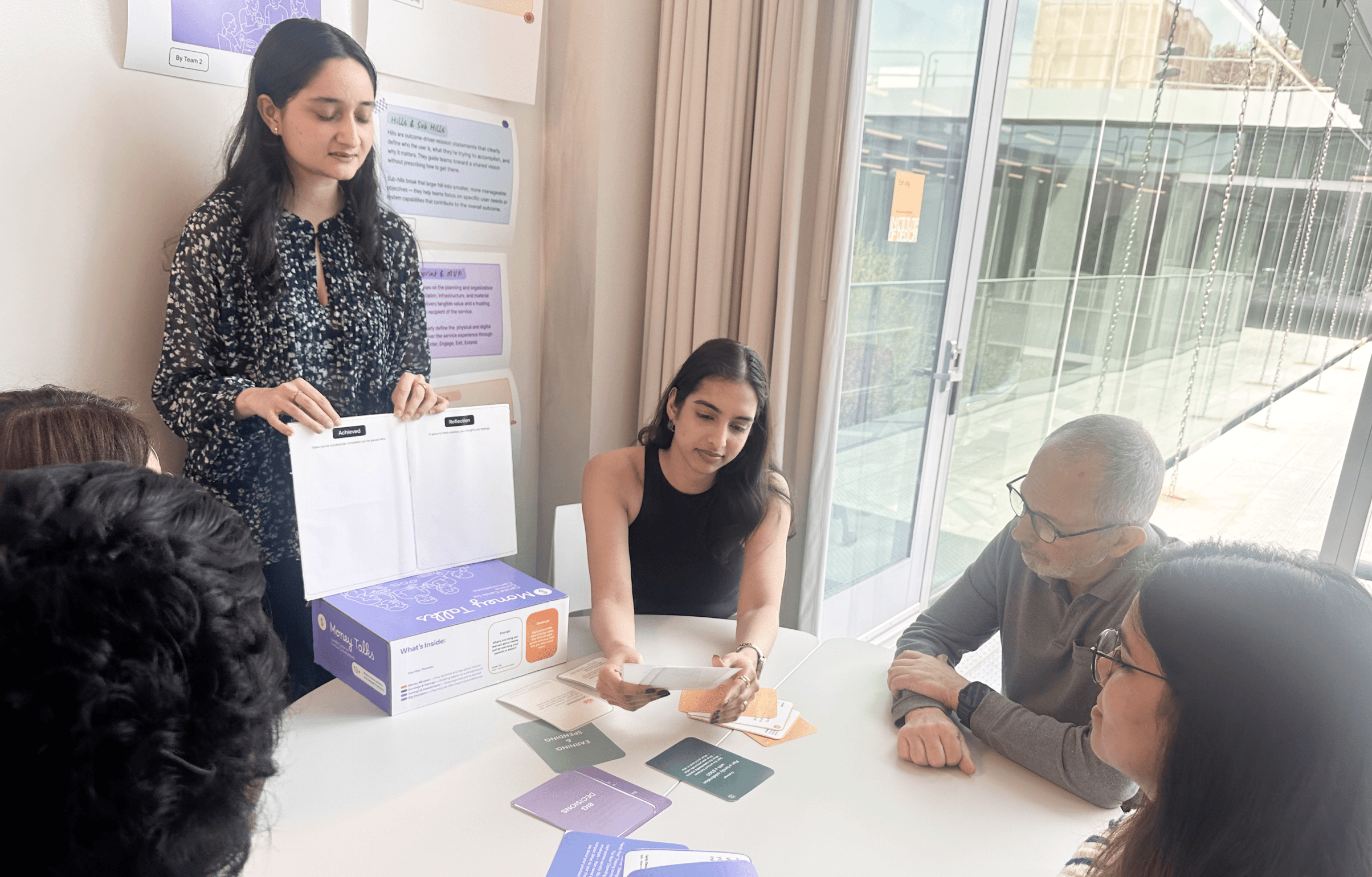
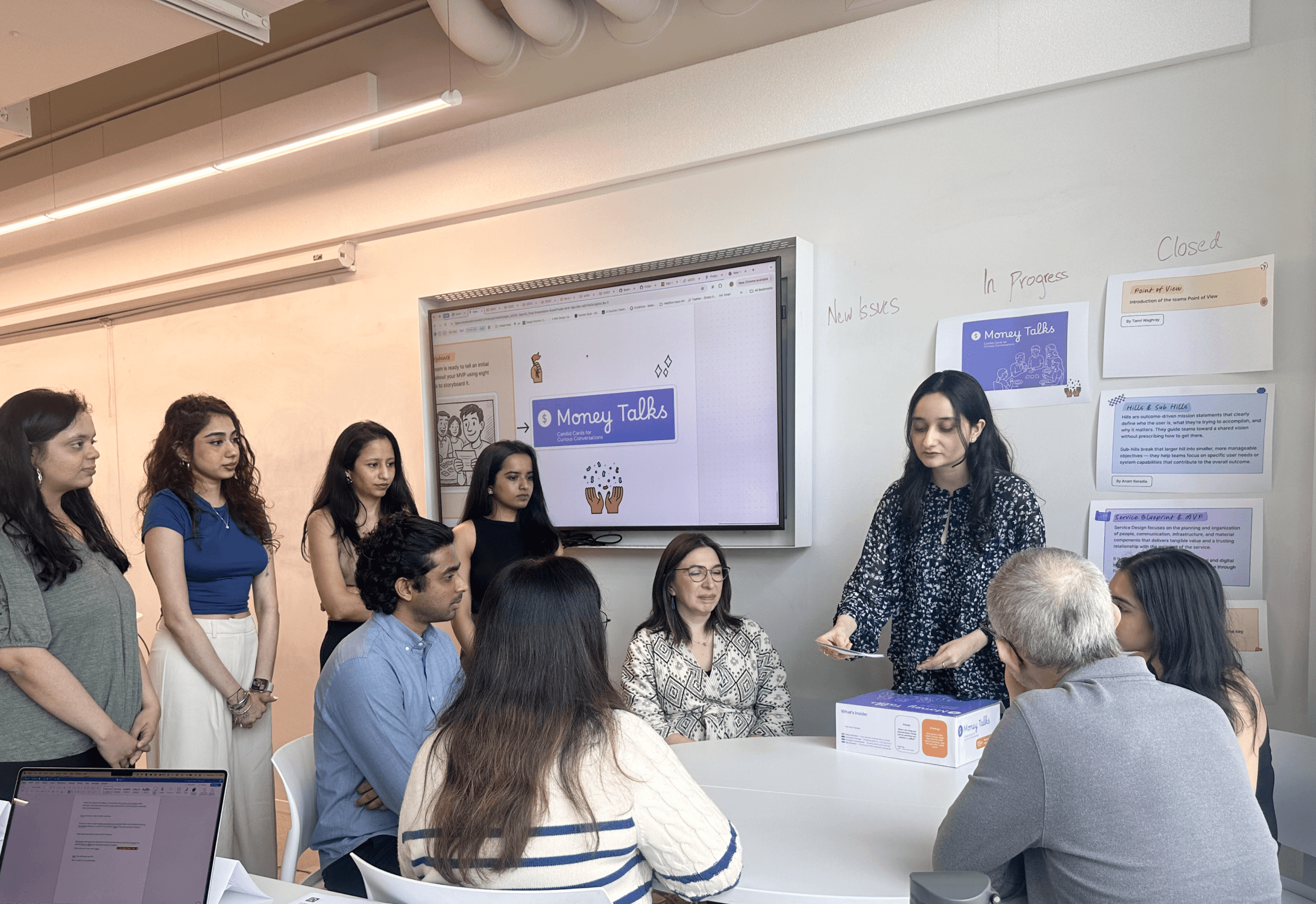
Presenting our game to guest critics.
Reflections and Learnings
Designing for conversations, not just outcomes
We realized that the real value wasn’t in parents teaching their children how to handle money, it was in creating a safe space for families to talk about money openly. The design needed to spark connection before education.
Emotions drive engagement
Early ideas focused on mechanics & digital tools, but user testing revealed that emotional cues, like humor, empathy, and curiosity, kept players engaged far more than the gameplay itself.
Frameworks brought clarity.
Using tools like Hills, Sub-Hills, the Amazon Press Release, Service Blueprints, and Storyboards gave our team clarity and helped us stay focused on building a game that truly delivered value to our users.
back to top
ANAM KORADIA 2025. ALL RIGHTS RESERVED.
HAND CURATED WITH LOVE, CARE & LOTS OF COFFEE ☕️
THIS WEBSITE IS BEST VIEWED ON DESKTOP
If you like what you see then let’s
connect and build something together.

Anam Koradia
Thank you for being here.